
Madagascar, the land of lemurs and baobab trees, wasn’t even on my short list of places to visit. However, an email arrived in my inbox from Galapagos Travel announcing a trip to this fascinating country. When I read the itinerary, I realized that unlike most packaged tours, this itinerary provided 3 and 4 nights at most locations and the 3½ weeks would allow us an opportunity to see quite a bit of the country, I couldn’t resist. I had gone to Galapagos (January, 2004) and to Antarctica (January 07) with Galapagos Travel. I trusted them and signed us up.
Madagascar is fascinating with its unique wildlife as well as a colorful history and culture. But it is a difficult country to visit, primarily because of the state of the roads and undependable flight schedules. For instance, it took 3 ½ hours to drive 50 bumpy miles from Fort Dauphin to Berenty reserve. It took 10 hours of driving on bumpy roads in a 4-wheel drive car, each way to get from Morondava to Bekopaka to visit the Tsingy. Well worth it – but grueling. This is not a trip to arrange on your own.
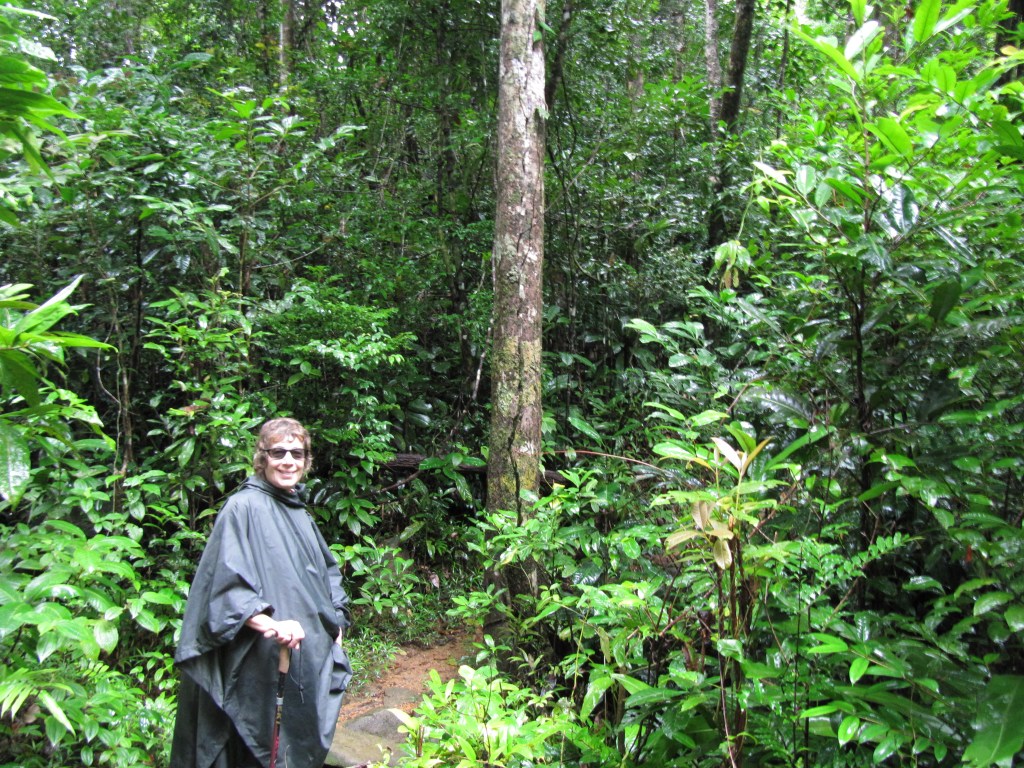
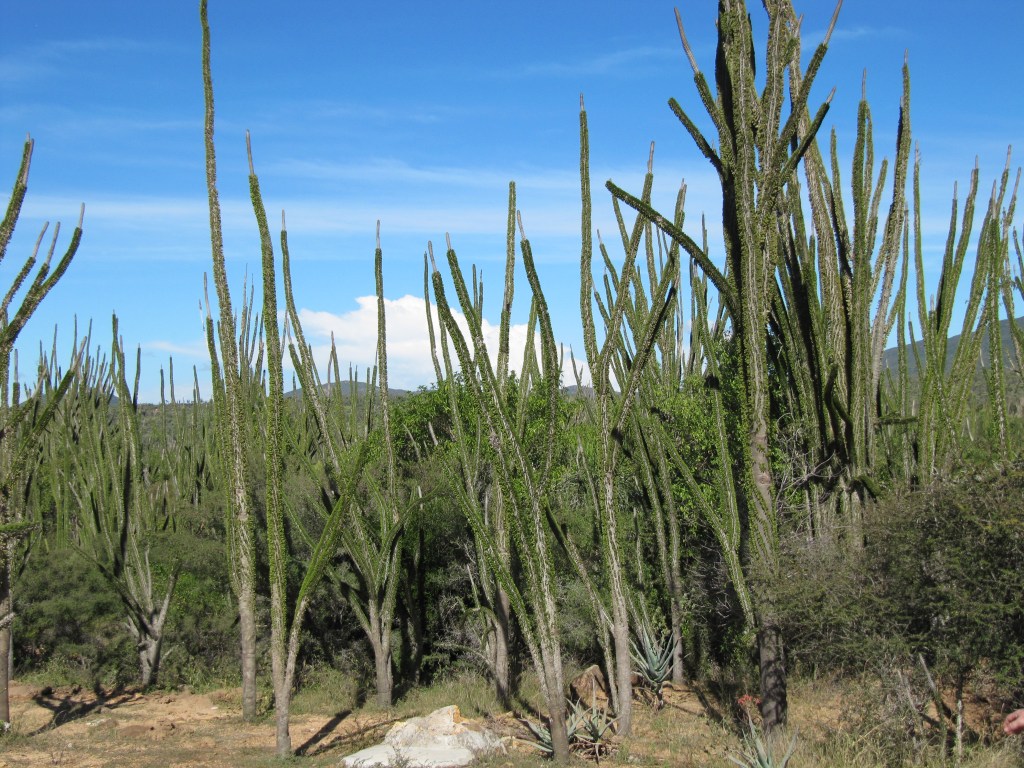
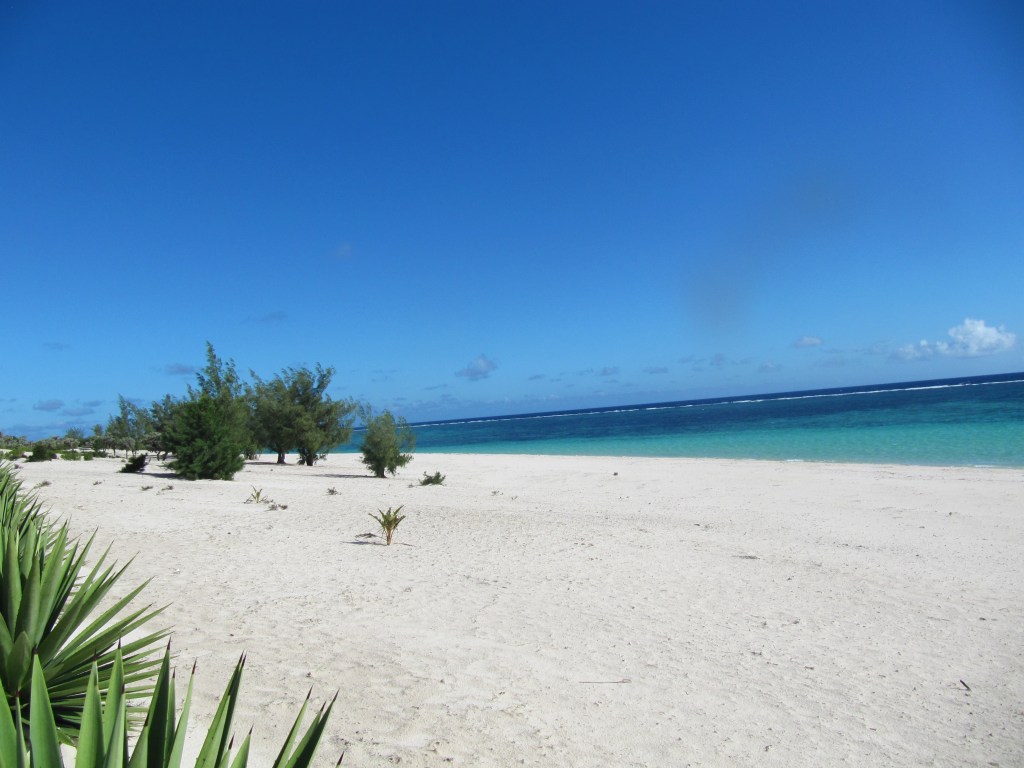
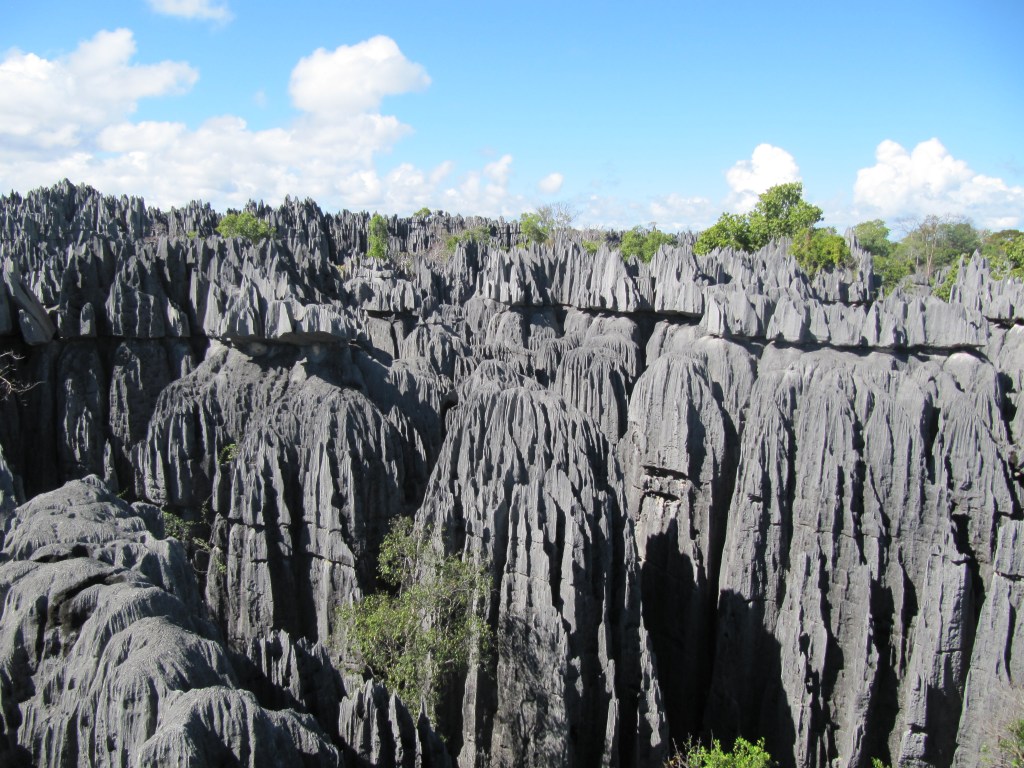
During the trip we covered diverse topography: the rainforests at Masoala and Perinet regions in eastern Madagascar, desert at the Berenty reserve in the south east, the lovely beaches of Ambola in the south west and the limestone Karst landscape, the Tsingy, in the west.
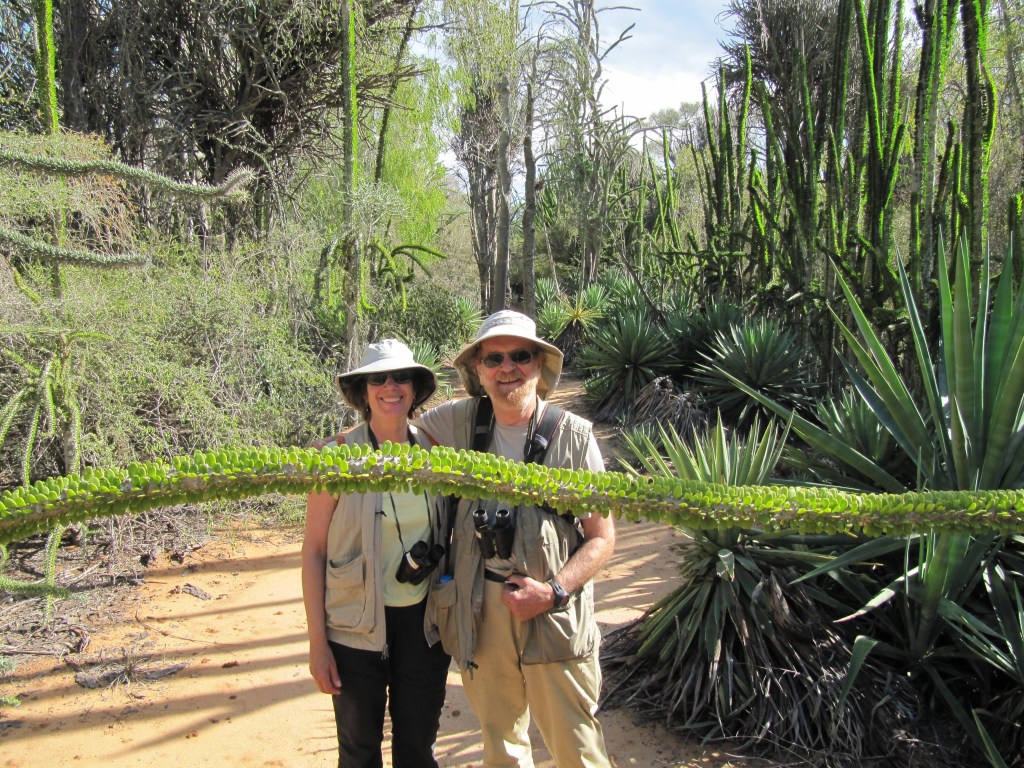
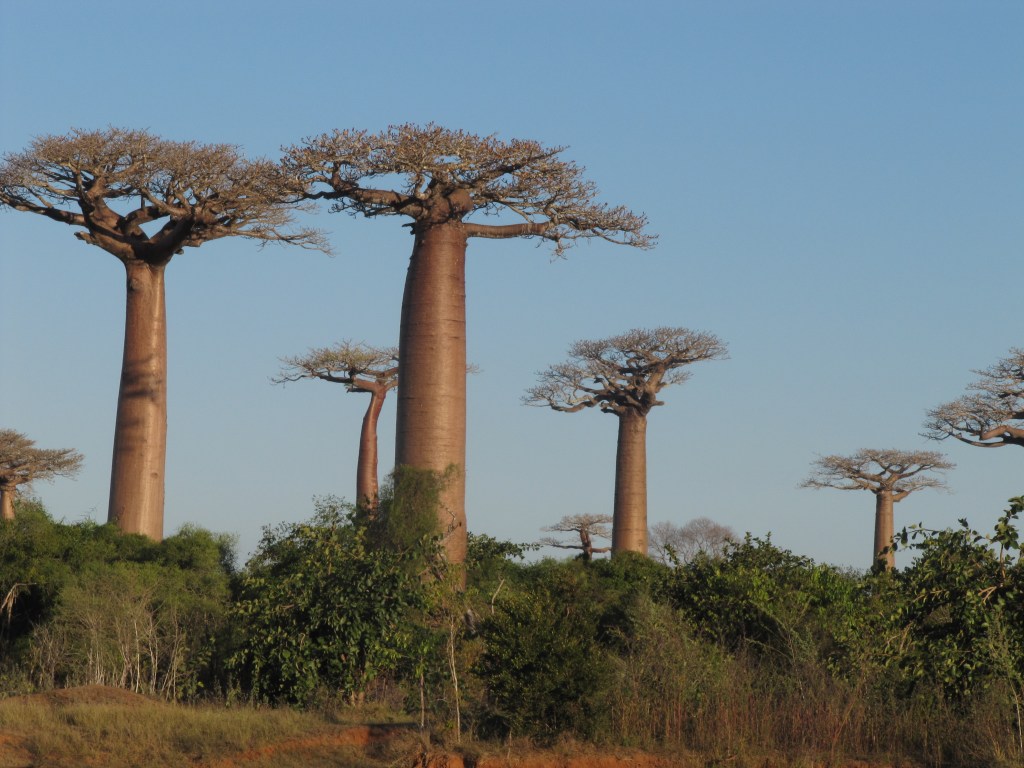
We saw many species of lemurs, chameleons, geckos, and birds as well as the spiny forests and the Baobab trees.
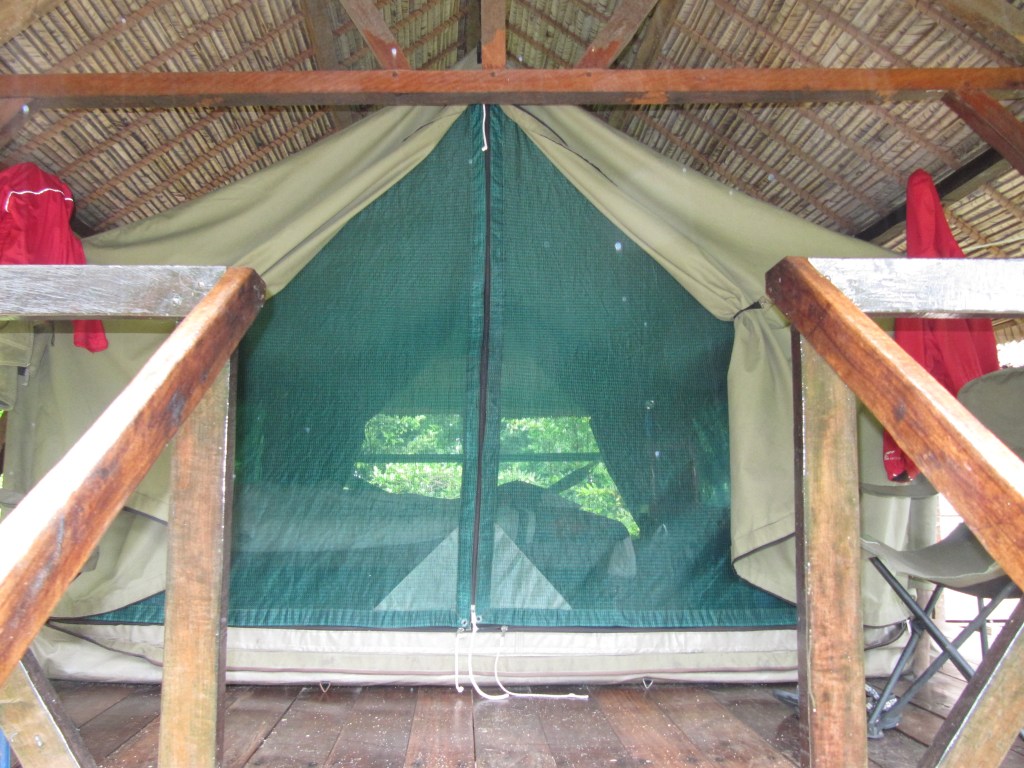
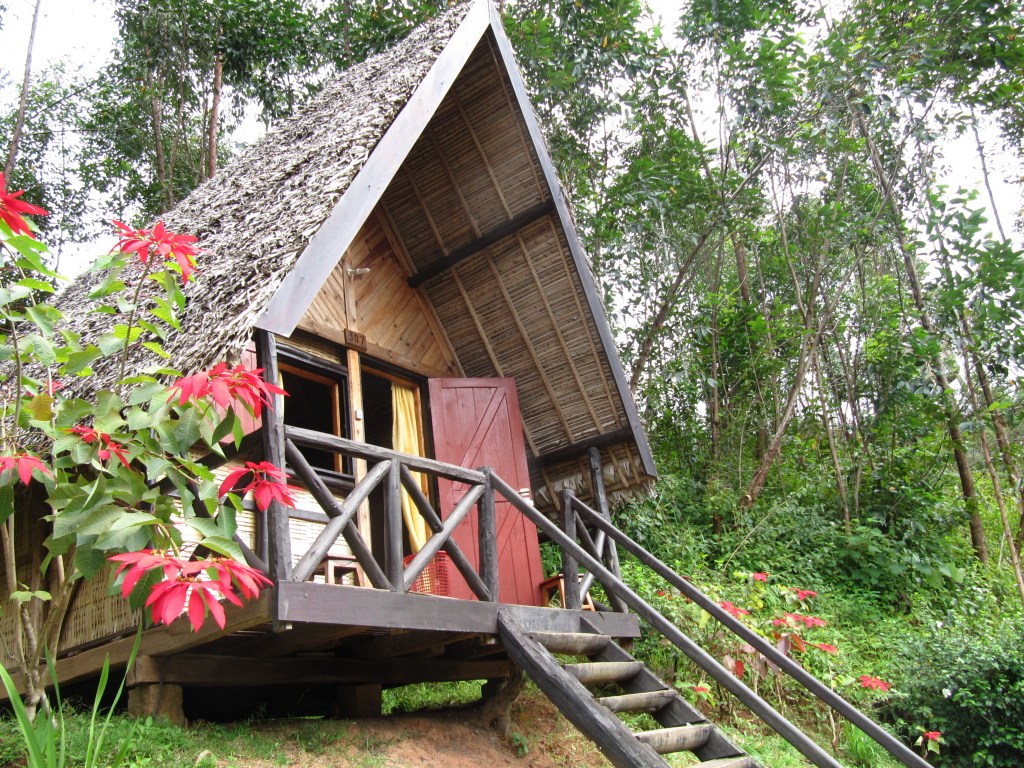
The accommodations varied by location, ranging from “camping” to very comfortable. This was an active trip, with pre-breakfast and nocturnal nature hikes as well as daytime activities whenever possible. There was some free time scheduled and we always had the option to pass on an activity.
Masaola Forest Lodge, Masaola Peninsula:
The trip began with an overnight Air Madagascar (Air Mad) flight from Paris arriving in Tana at 4 AM. The connecting flight to Maroansetra, scheduled for 7 AM, was delayed to noon. This was the first of many delays and re-schedules. From the Maroansetra we took a 1-hour boat trip to Masoala Forest Lodge in the Masoala National Park for our three-night stay.
After 24 hours of travel, we waded off the boat into shore at Masoala and saw a bit of paradise. Masoala Forest Lodge is surrounded by rain forest, which comes down almost to the beach itself.
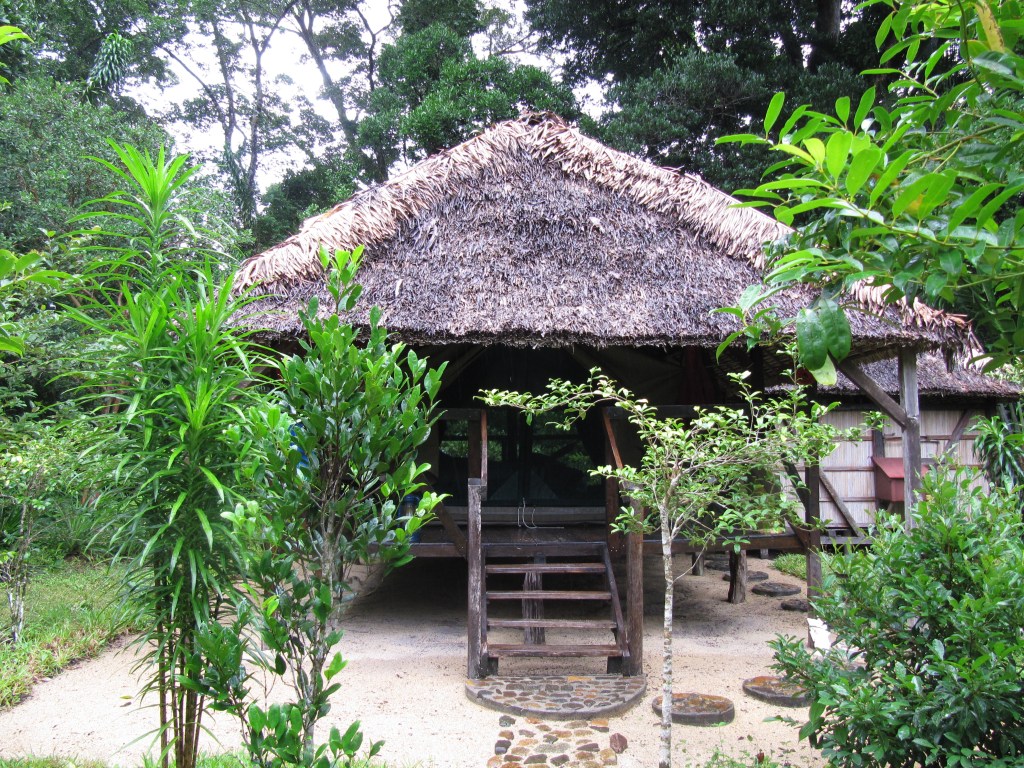
The Lodge was made up of six twin-tented cabins with adjoining private toilet/shower facilities for each cabin. Each cabin also had a pleasant front porch and a small area in back with a hammock. The dining room/meeting room was open and airy.
Since it had taken so long to get to the lodge, our first event was a nocturnal nature walk. There is something magical about walking through the forest, in light rain, with flash lights and spotting a leaf-tailed gecko, a frog or the eyes of a mouse lemur (two red spotlights at the top of a tree).
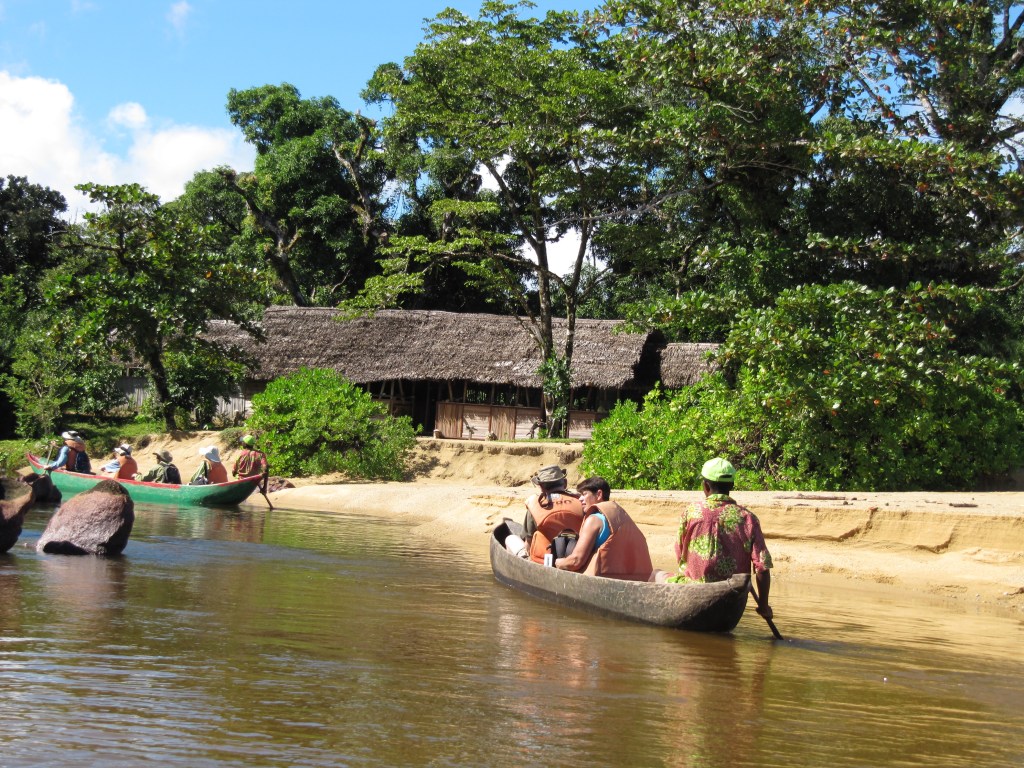
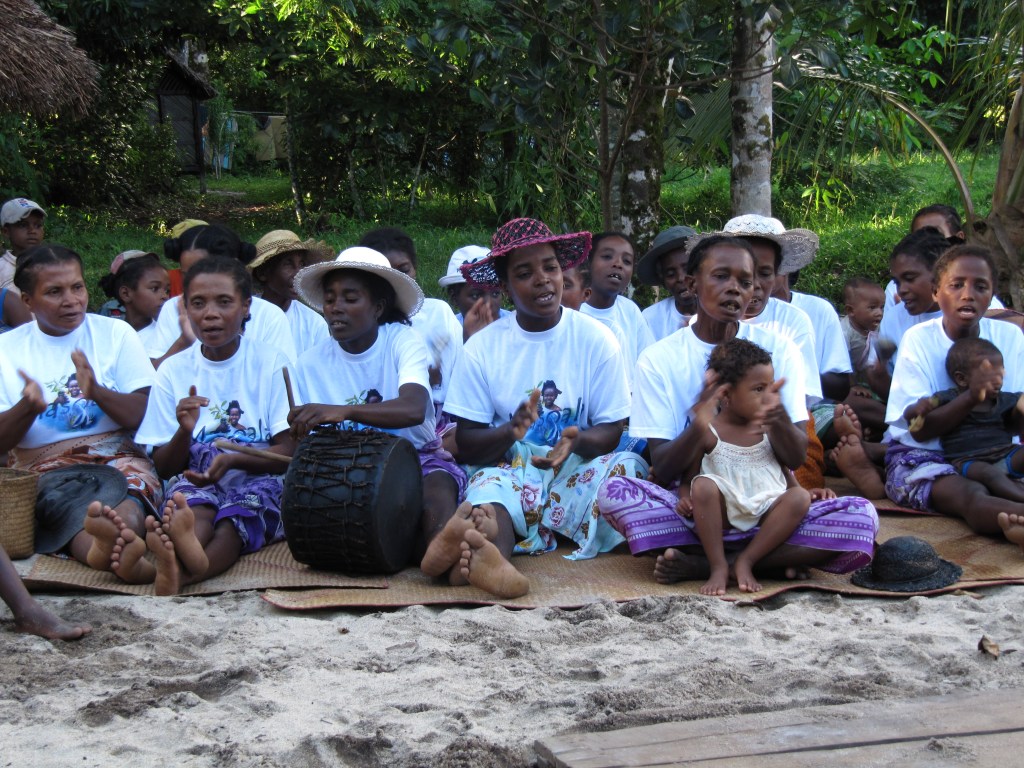
While at Masoala, we hiked, canoed and visited the villagers nearby. We saw their vanilla beans, pineapples and bananas. They also came to sing and dance for us at our camp. During our down time, I went swimming in the calm, warm Indian Ocean and relaxed in the hammock.
Berenty Private Reserve
We flew via Tana (the capital) to Fort Dauphin and drove 50 bumpy miles to the reserve. The roads have not been re-paved in 50-years; therefore, it took us five hours (including stops) to reach the reserve.
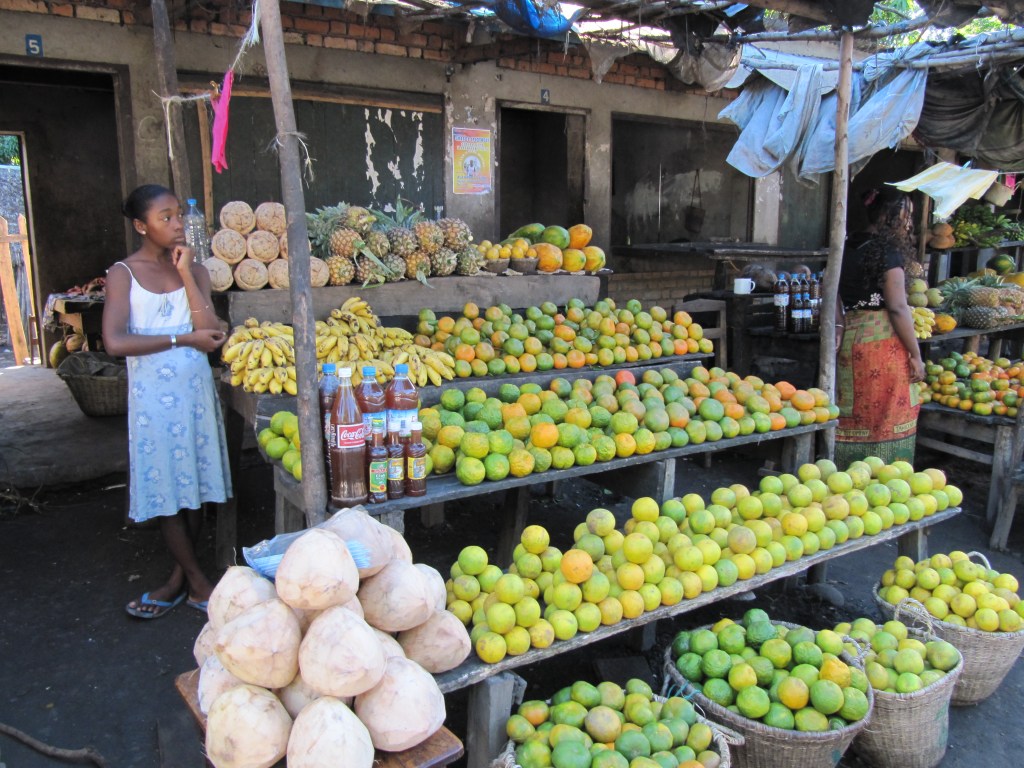
Along the way we saw the countryside and the vendors displaying their fruits, vegetables and art work. This display is definitely picture worthy.
When we arrived, a troupe of ring-tailed lemurs greeted our van and it only got better from there.
Berenty is totally different from Masoala. The weather is dry, the terrain sandy and level. We went on morning, afternoon and evening nature walks during our 2-night stay at Berenty. (It was supposed to be a 3-night stay, but Air Mad changed flight times; therefore we had to change our itinerary).
We saw many types of lemurs but the Verreaux Sifaka was the most fun to watch. These Sifakas are white with black faces and hop like kangaroos, only sideways. When they reach their destined tree, they seem to just lift themselves up effortlessly.
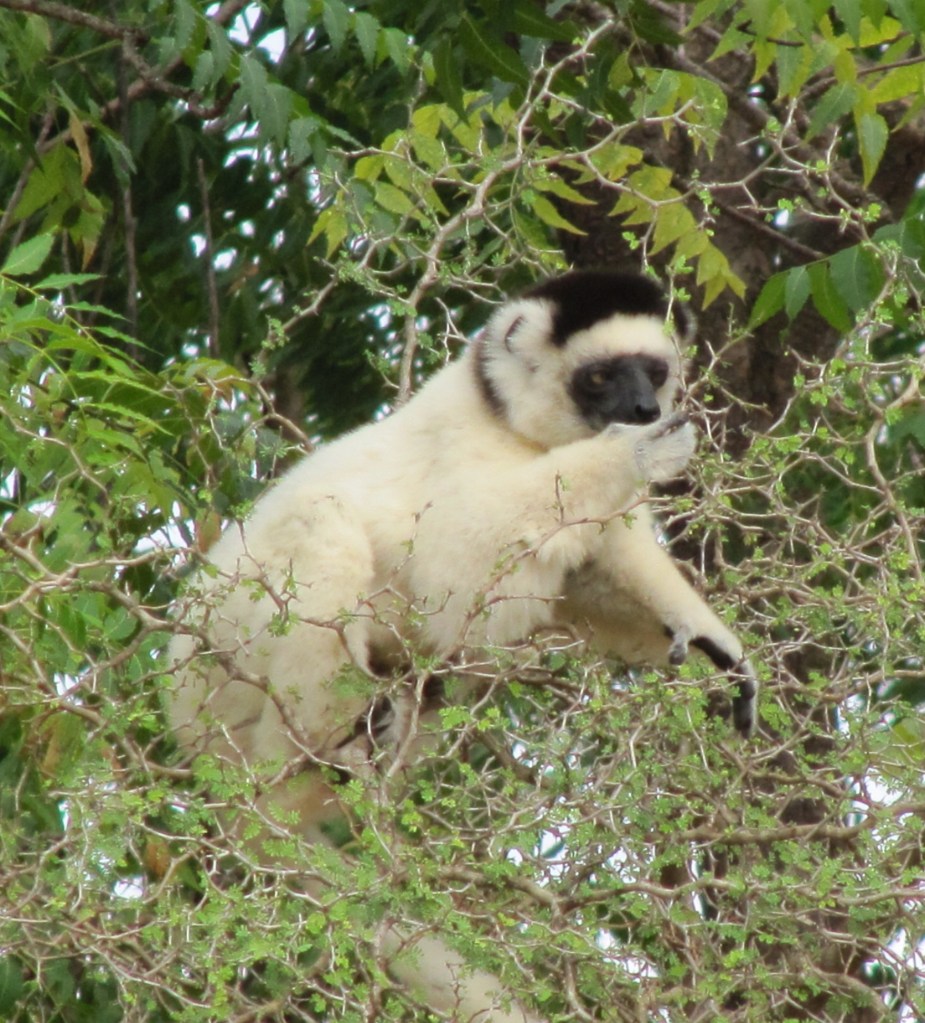
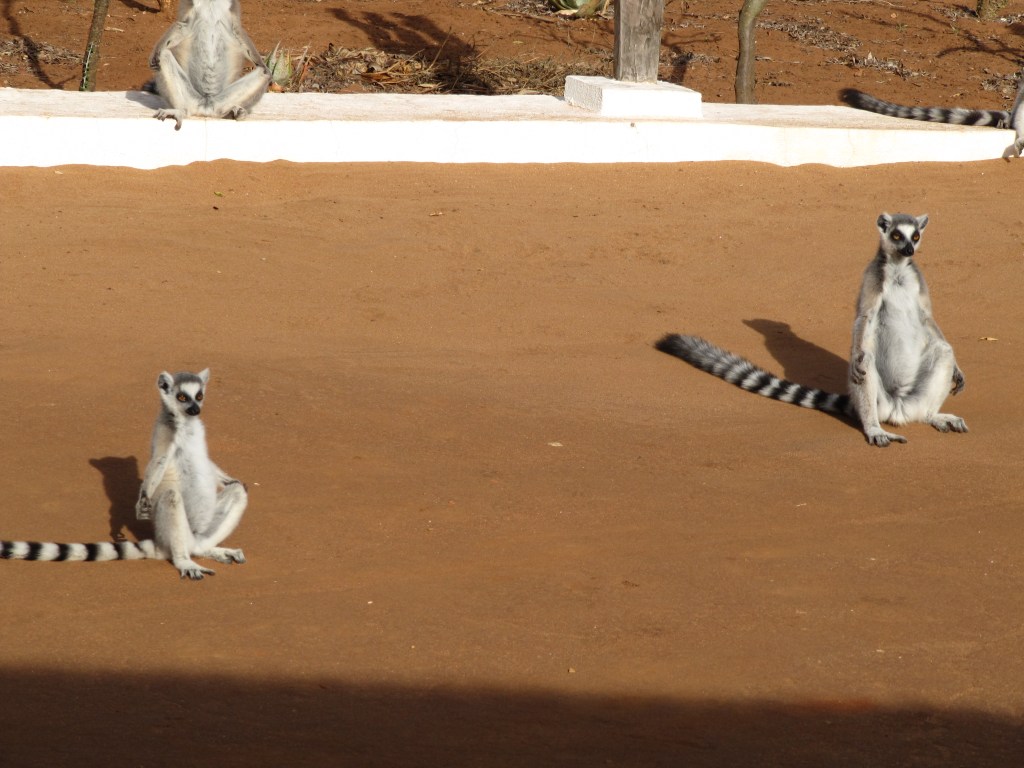
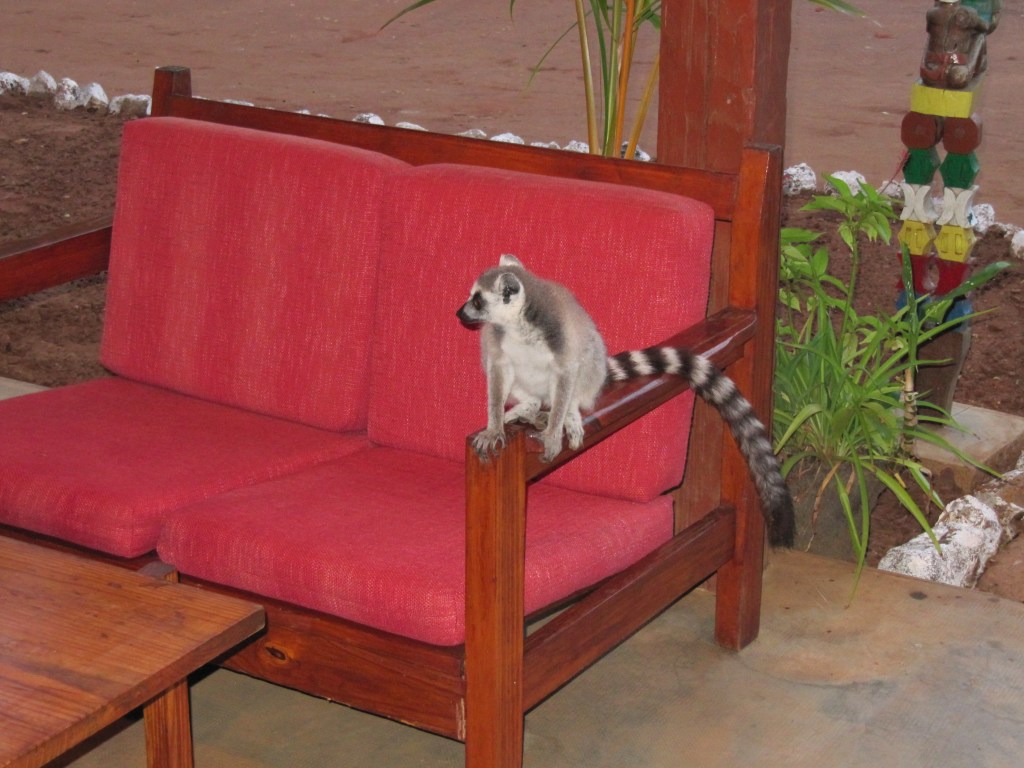
It was a treat to watch all the various lemurs scurry up and down the trees. The ring-tailed were very bold, venturing on the furniture in our breakfast room. They like to sun themselves and sit with legs and arms spread out.
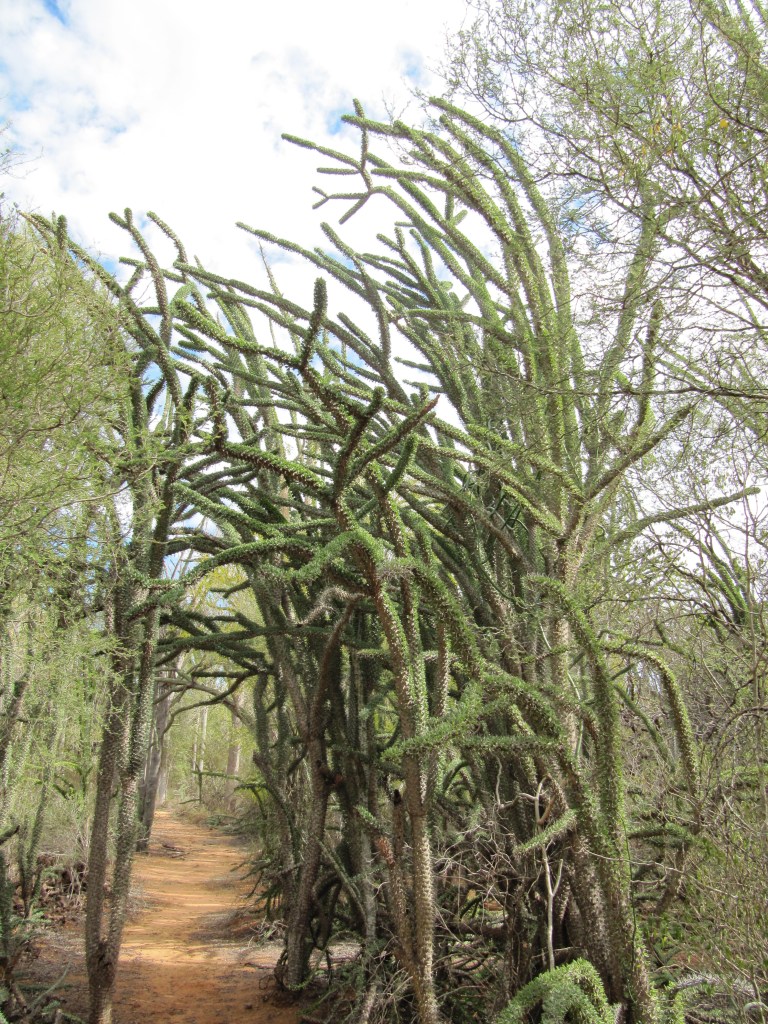
We had delightful walks in the spiny forest. The trees are unlike any that I had seen before. I especially liked the “Octopus tree” whose many branches intertwined in interesting patterns.
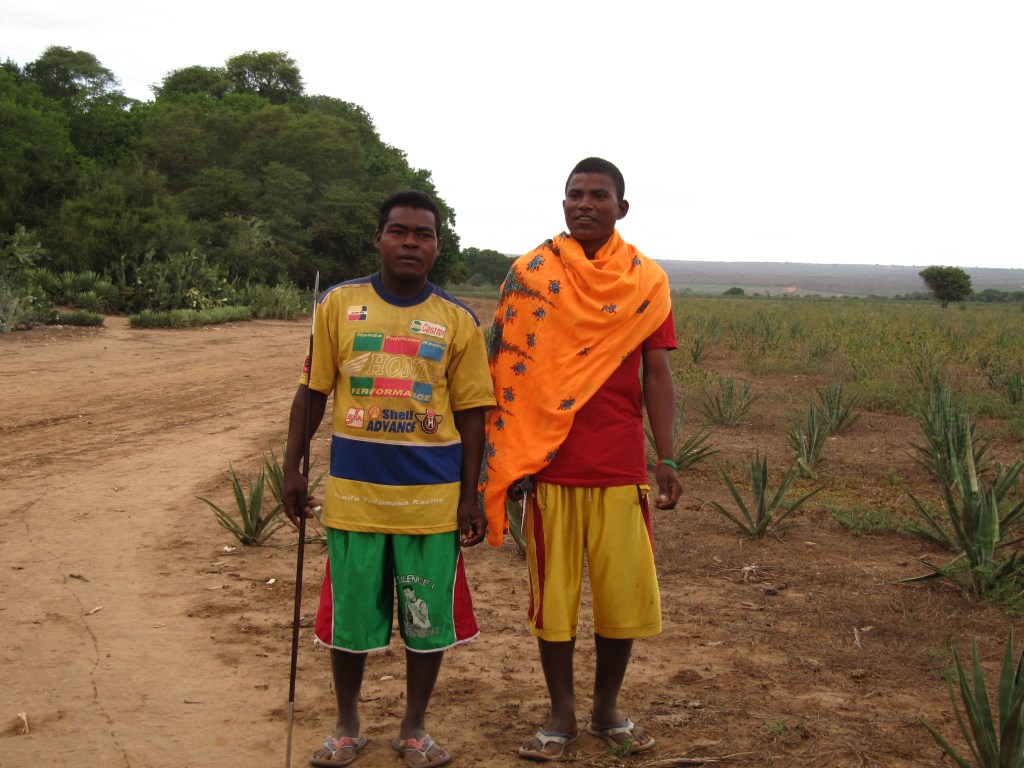
We learned about the medicinal value of the plants and about the local people (who still carry a spear on their walks, even though they no longer fight neighboring tribes).
Ambola and Tsimanampetsotsa National Park
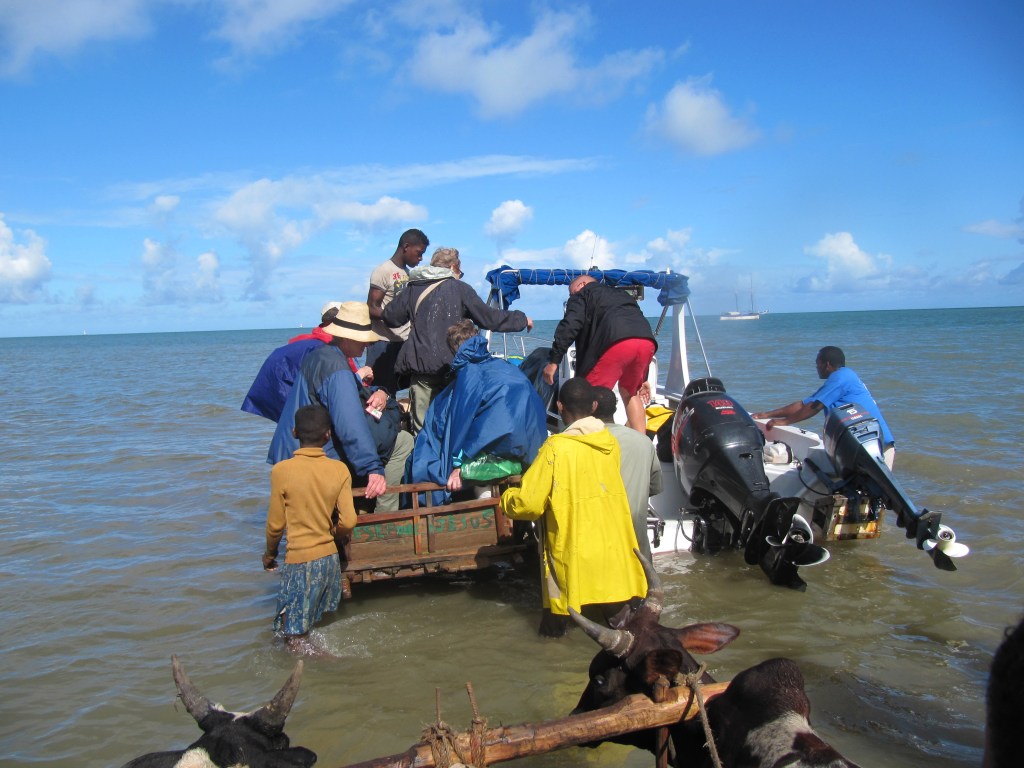
We flew from Tana to Toliara and then were transferred by van, and zebu (cattle) carts to the boat, which was docked about a mile out to sea due to the low tide. To the left is our crew being moved from the Zebu cart to the boat.
After a very wet 1- hour boat ride, we transferred to a 4-wheel vehicle for the 1 ½ hour ride to our beach resort, Domaine D’Ambola.
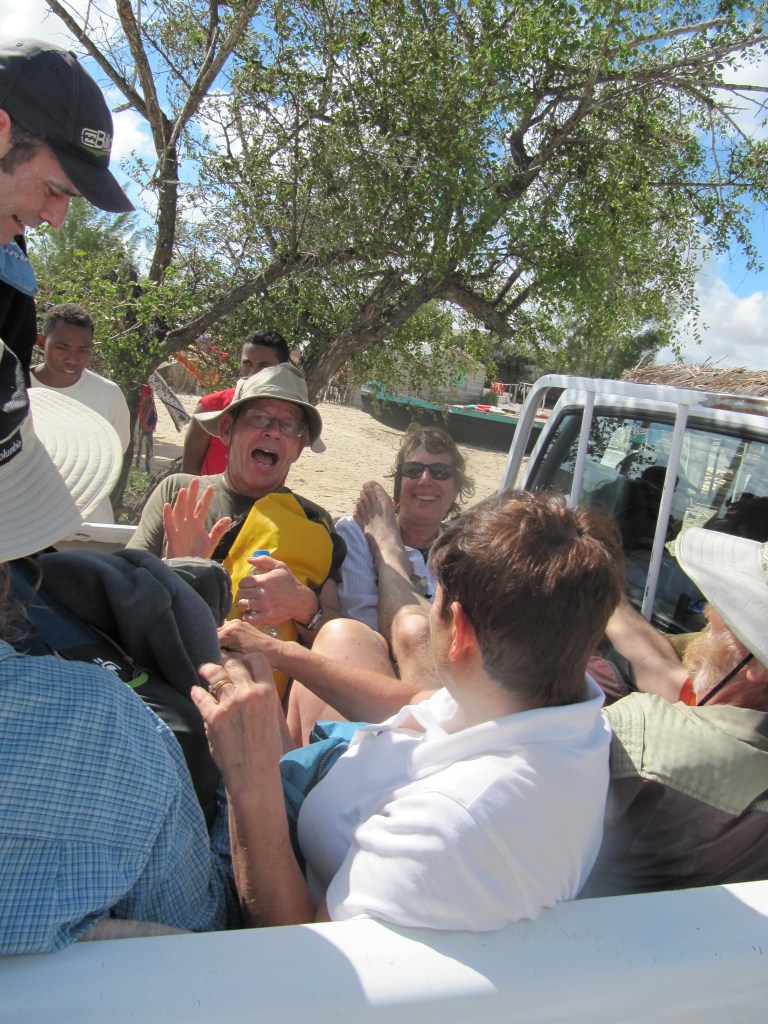
We were supposed to have two 4-wheel vehicles, but one was stuck in the mud somewhere; therefore 11 of us plus the driver piled into the one vehicle. It was an exceedingly uncomfortable 1 ½ hours but we made the best of it and sang songs and laughed a lot.
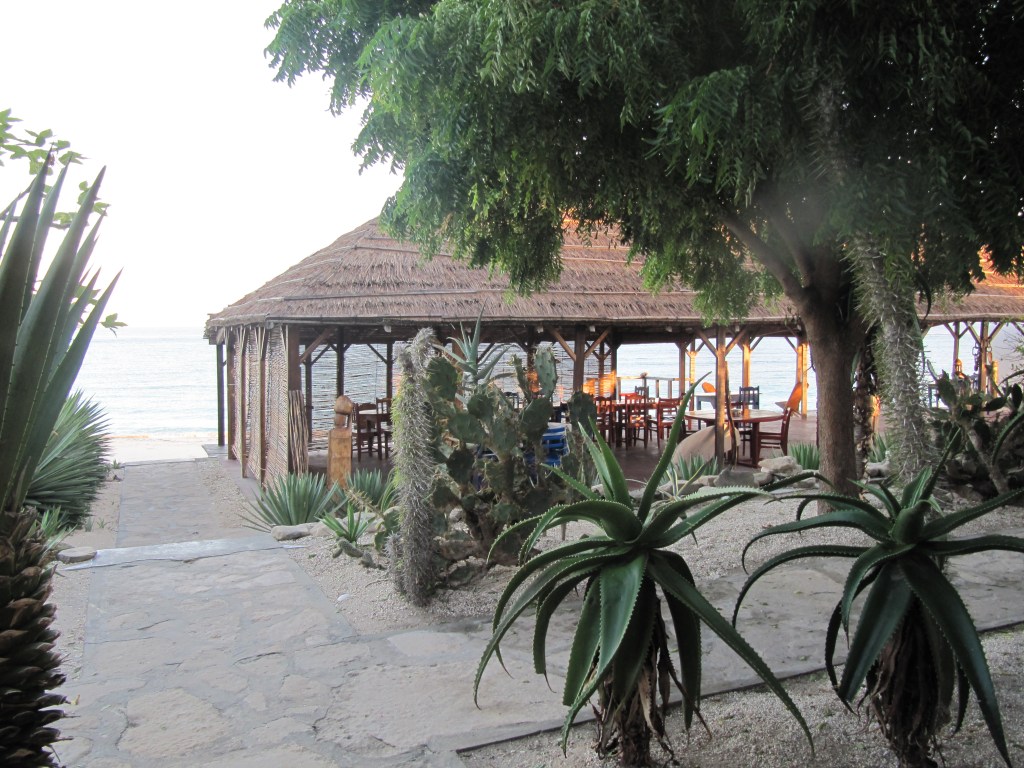
Domaine D’Ambola is located on a magnificent white sandy beach on the Indian Ocean. As soon as I saw the resort and the beach, the travel fatigue disappeared.
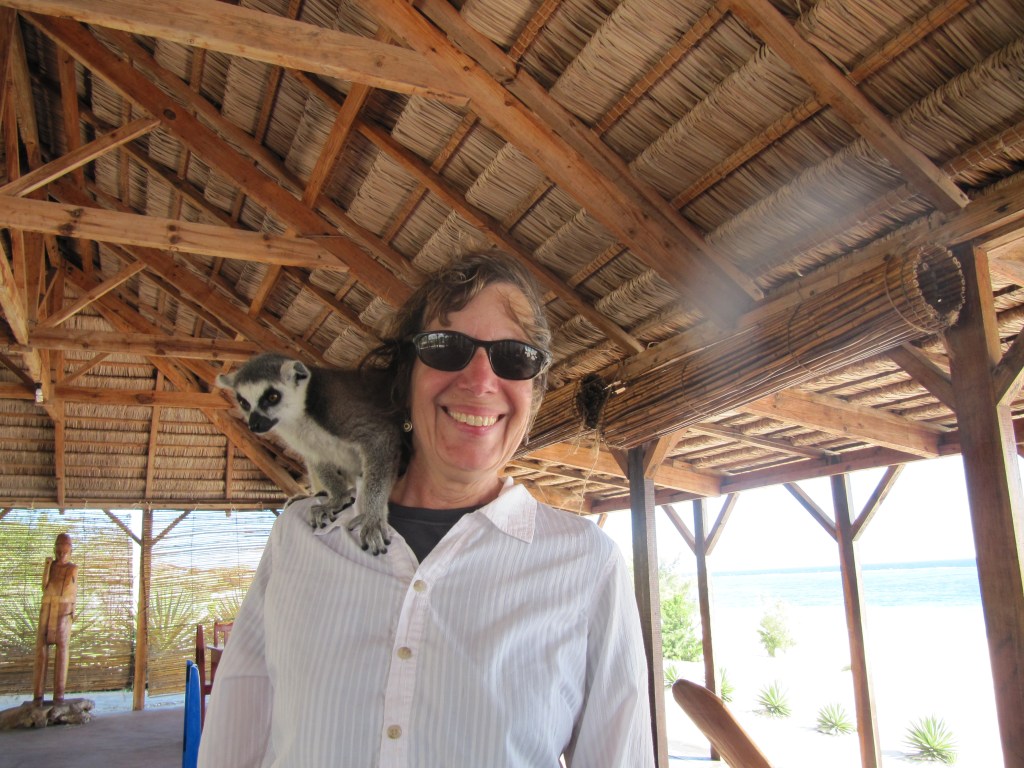
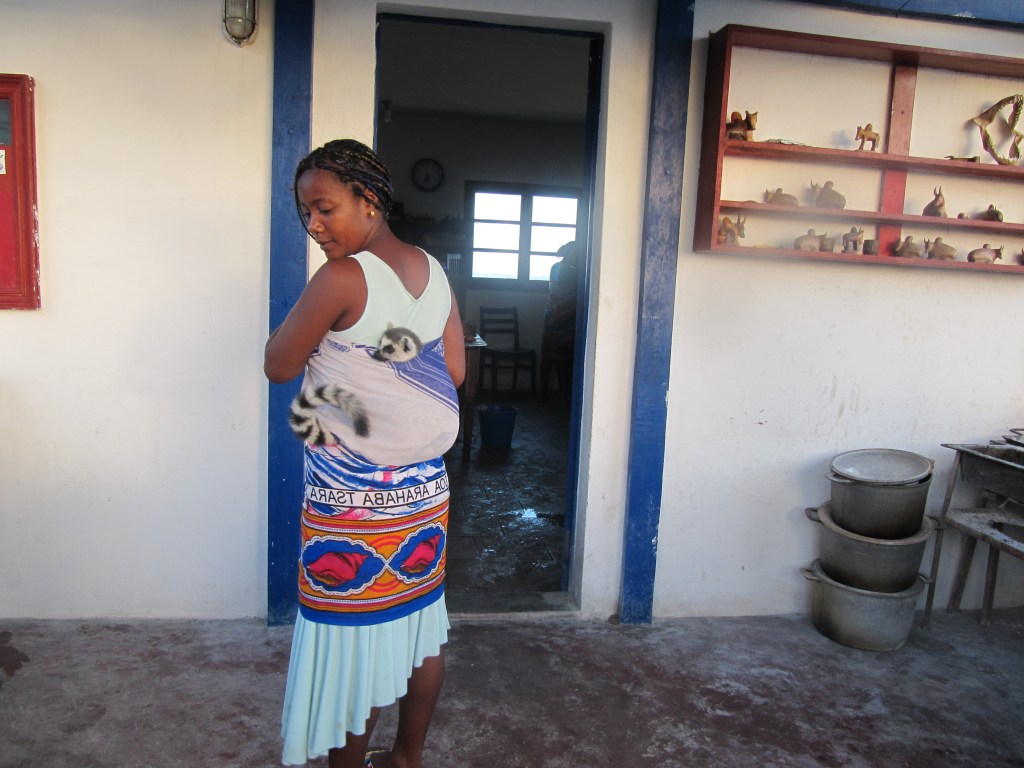
The staff at the resort had adopted an orphan ring-tailed lemur, Tobi. He was still very young and had the run of the place. We had to ask that he be kept away at meal times, (otherwise he stole food from our hands).
To keep him “caged” up, one of the staff people put him in sling on her back. He loved being carried like that and would go right to sleep with his tail hanging out of the sling. Tobi spent much of the time nuzzling us.
About 2 miles from the resort is the Tsimanampetsotsa National Park. The park encompasses a Salt Lake where the Greater Flamingos live for half the year. They were in residence. We visited a cave with blind fish, who are completely white being always away from light.
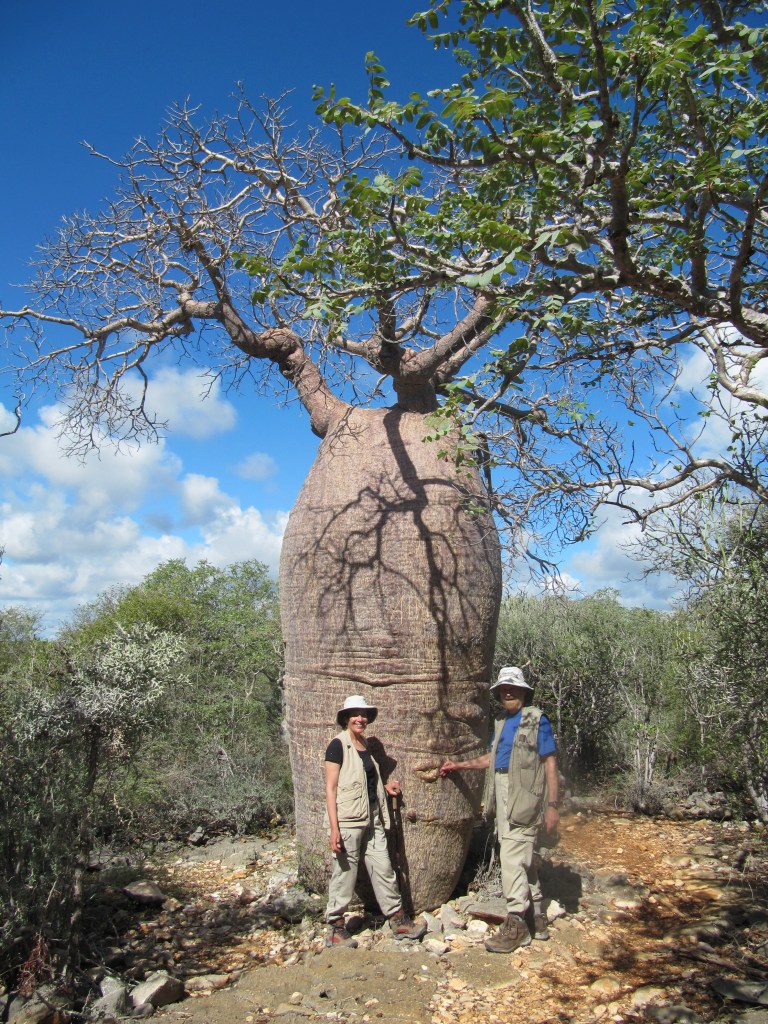
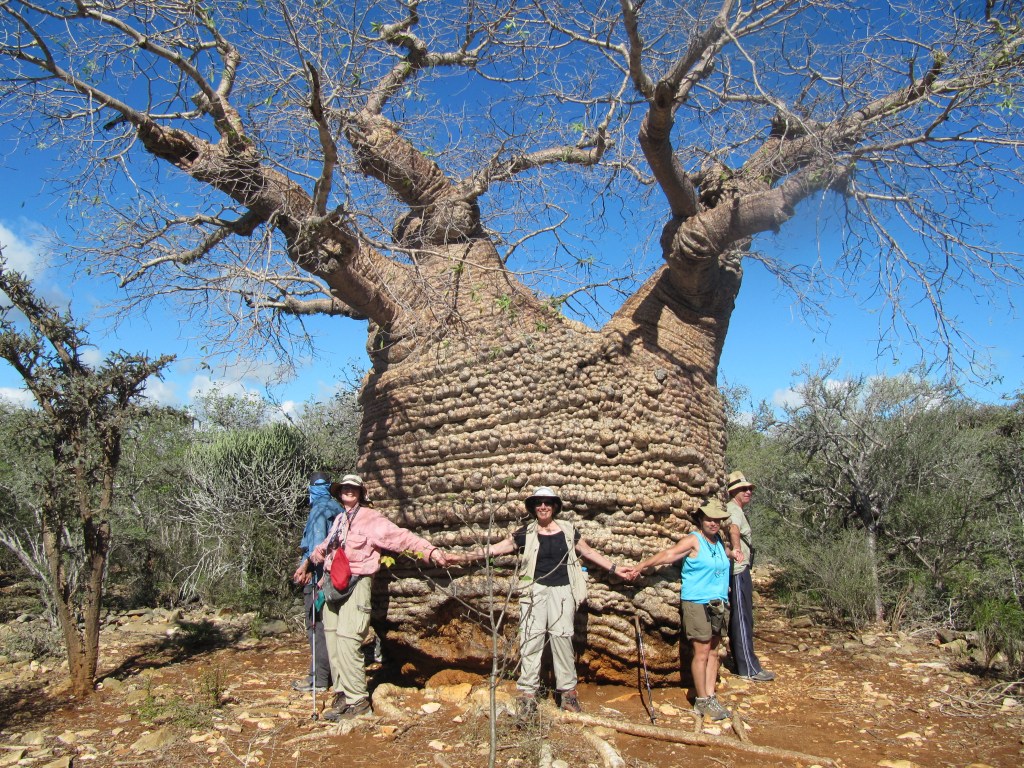
But the most exciting, was seeing the ancient Baobab trees. We heard conflicting information, but the Grandma Baobab seems to be about 3,000 years old. She is all wrinkled and stooped over. Some of the baobabs are only about 1,000 years old. They are protected in the National Park.
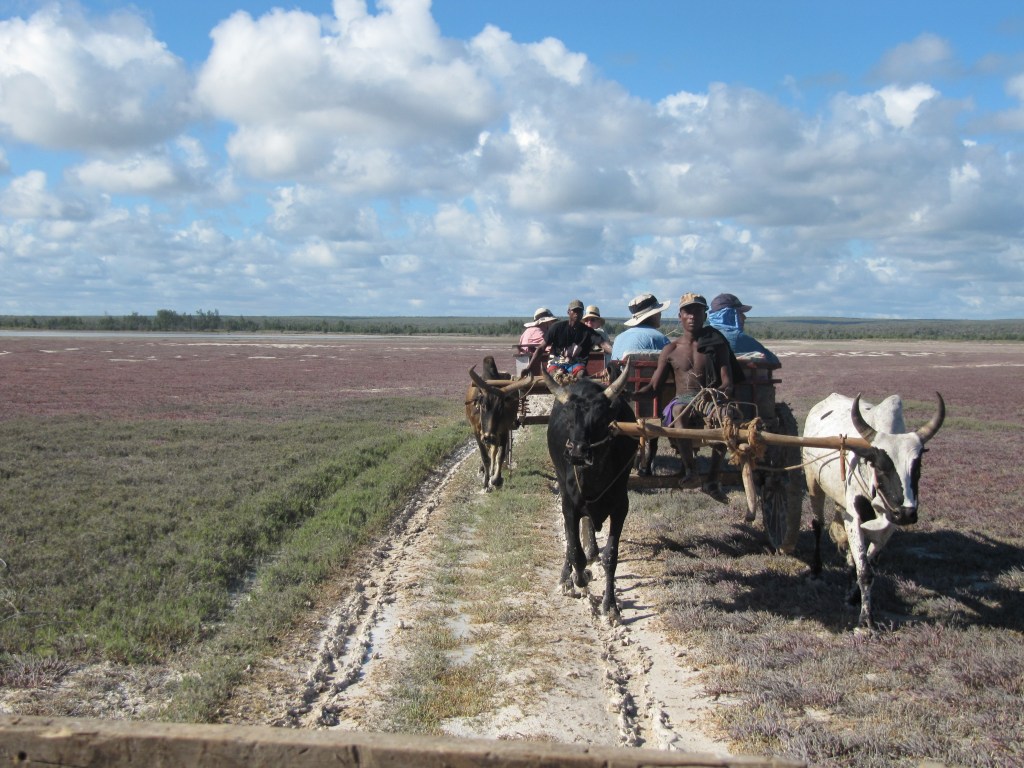
To tour the park, we traveled the local way, in zebu carts. The ride was extremely bumpy and uncomfortable on the rocky paths even though we had cushions. The 4-wheel vehicle that picked us up to return to the resort felt luxurious in comparison.
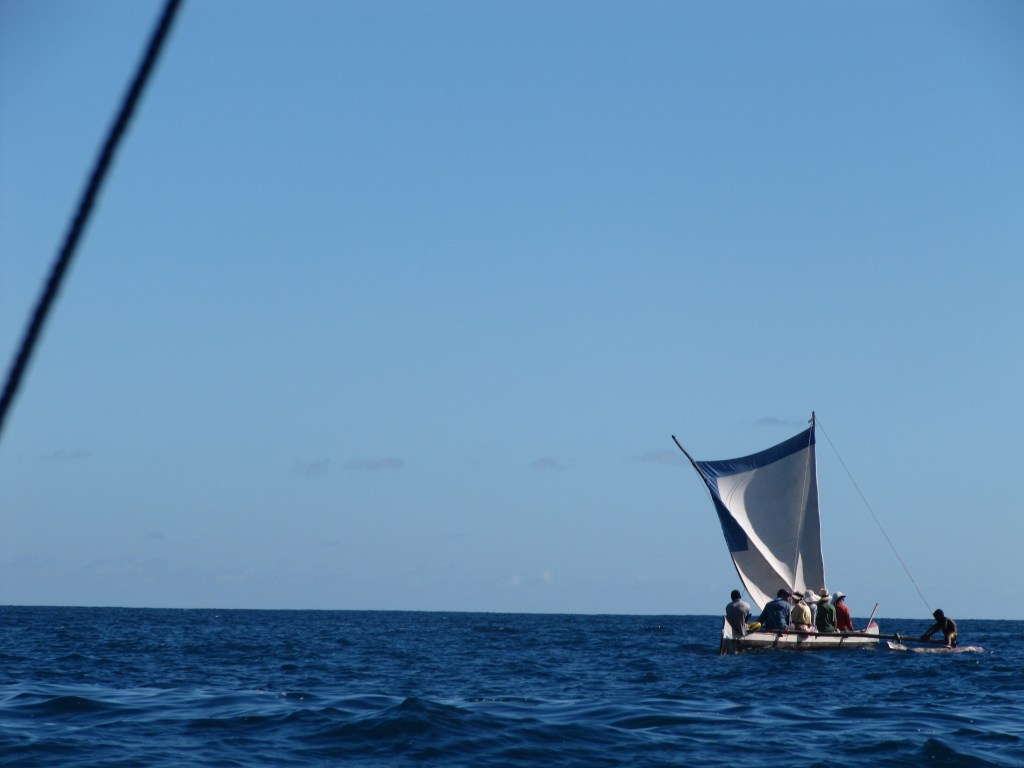
During our stay at Ambola, we also went on a sail in a dug-out canoe, as well as had free time to walk to the tiny village of Ambola, to swim and sun on the deserted beaches or rest at the resort.
Kirindy Lodge and The Tsingy
Getting to Berenty and Ambola was difficult, but it was nothing compared with getting to the amazing Tsingy area near Bekopaka. We took a short flight (1 hour) from Toliara to Morandava then drove in three 4-wheel vehicles, through the Avenue of the Baobab (more of that later) to the Kirindy Forest Reserve, where we stopped for the night.
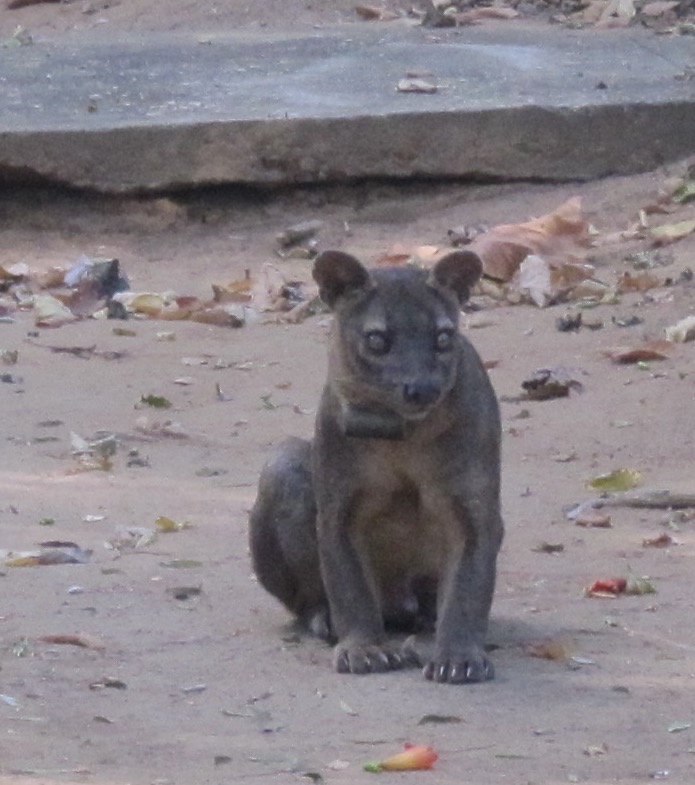
The Kirindy Lodge was a great place to stop because it allowed us to break up the trip, as well as see interesting animals, such as the Fosa. This animal, the size of a medium dog, which resembles a cat, is one of the few lemur predators.
We also saw the Giant (size of a rabbit) Jumping Rat – the camp is on his nocturnal route. On a nocturnal hike, we saw varieties of nocturnal mouse lemurs and red spotted lemurs. They are just darling, small enough that one can hold them in the palm of one’s hand. We also saw chameleons, nocturnal geckos and an owl.
It was delightful to watch Sifaka lemurs jump from tree to tree. They are absolutely amazing and I could sit and watch them for hours. Our guide told us that the scientists have learned that Sifakas have one female in the troupe that acts as a mid-wife. She helps with the birth. One male acts as a medicine man and gathers certain herbs after a birth to give to the new mother to help with post birth bleeding. They also have a special cry to announce a successful birth.
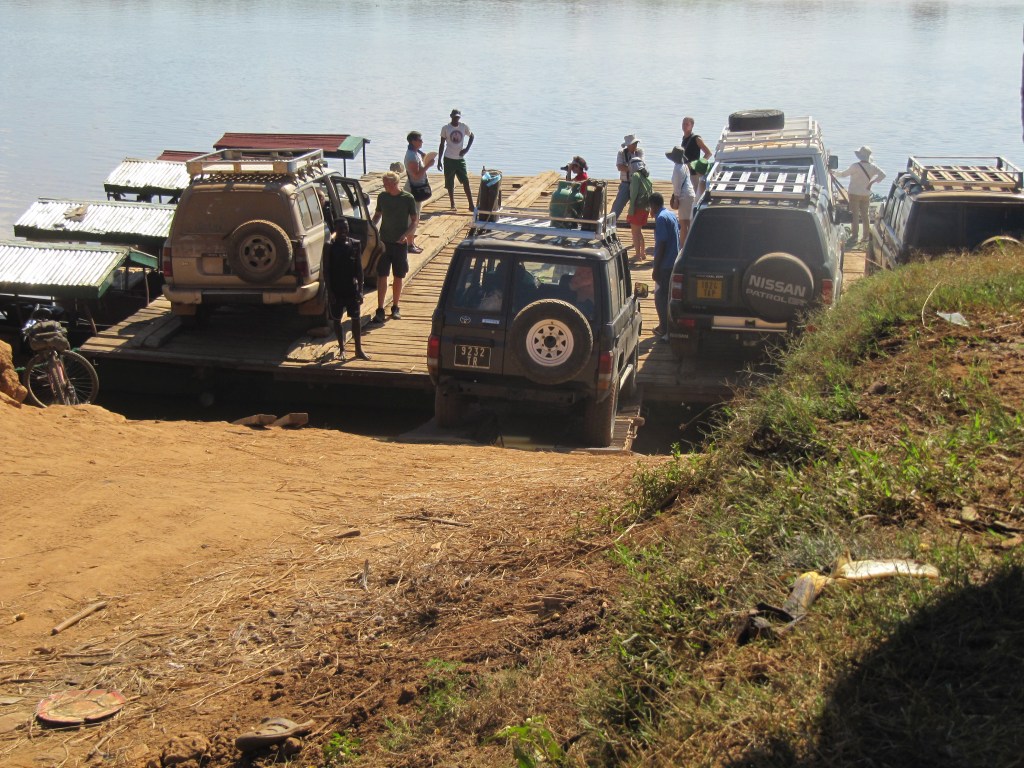
We continued to the Tsingy area, crossing in a car ferry. This was a slow affair because in order to get the 8 vehicles on the ferry, they needed to be maneuvered using a second ferry. The 40-minute ferry trip was the only smooth part of the ride that day.
About 9 exhausting hours later, we arrived at the beautiful Hotel L’Orchidee just outside Bekopaka. The hotel, which is surrounded by flowers, was very comfortable with cabins which had reliable hot showers – something you grow to appreciate.
The reason to be in Bekopaka is to be able to climb the Petite and Grand Tsingy, which are UNESCO World Heritage sites.
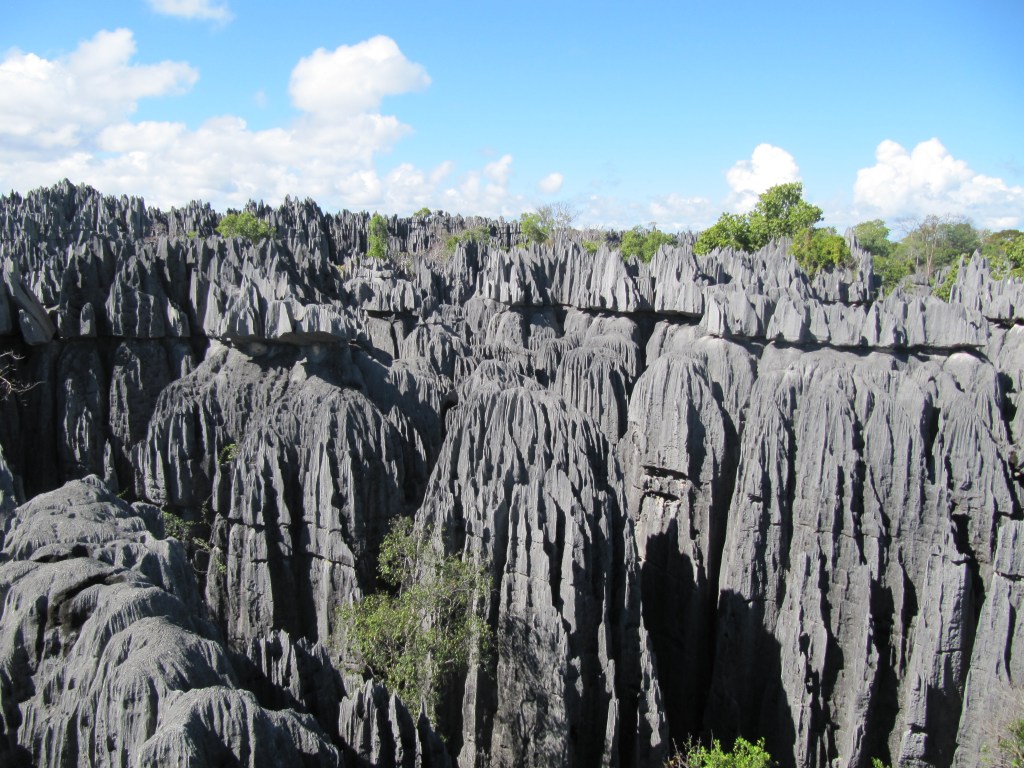
The Tsingy is made up of beautiful jagged rock formations, from limestone karst, which have been carved by nature over millions of years. During our three days in the area, we hiked in both Tsingys as well as explored the Tsingy caves from the river in pirogues.
Hiking in the Petite Tsingy was invigorating and interesting but not very difficult. However, hiking the Grand Tsingy is not for the faint of heart. We wore harnesses with carabineers, which we hooked on wires bolted into the rocks. The climbing involved finding footholds, pulling ourselves up by the jagged rocks. Luckily I brought gardening gloves to hold on to the rocks, which saved my hands.
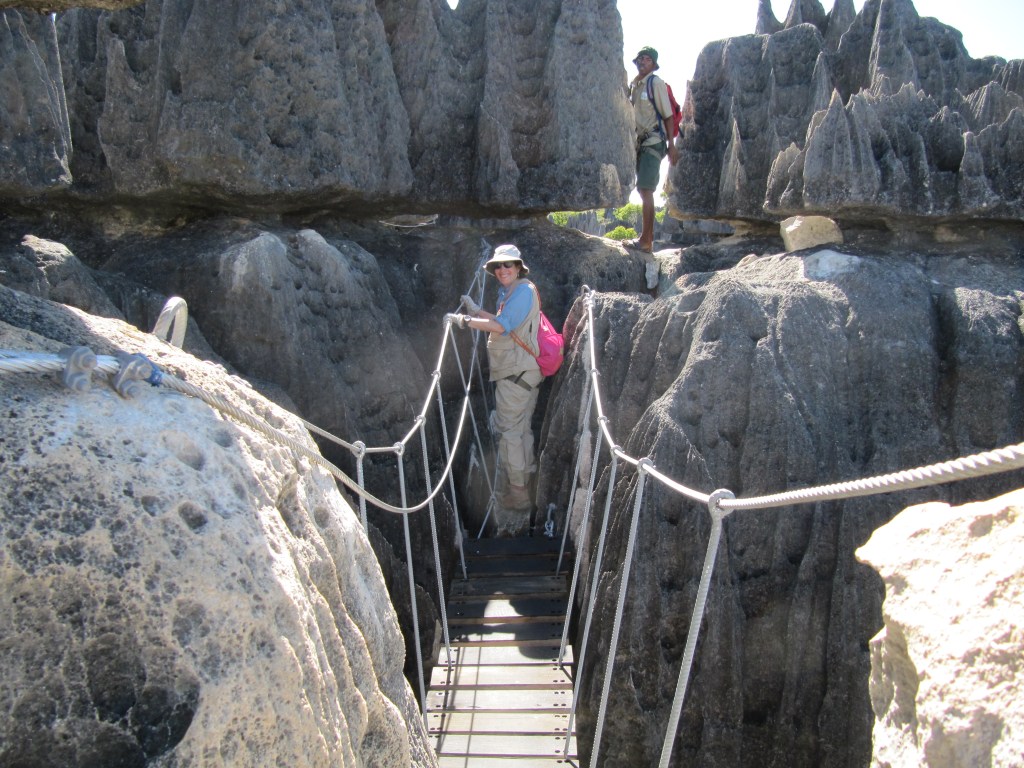
We crossed suspension bridges. Other times we crawled on all four getting through the caves. We stopped at two viewpoints to look at the amazing rock formations, which made it all worthwhile. The Tsingy is an absolutely beautiful place. We hiked for almost 7 hours mostly vertically, going up and down rocks.
Our drive back to Morondava was long (10 hours on bumpy roads and 2 ferry crossings) but it was properly timed to arrive at the Avenue of the Baobabs at sunset.
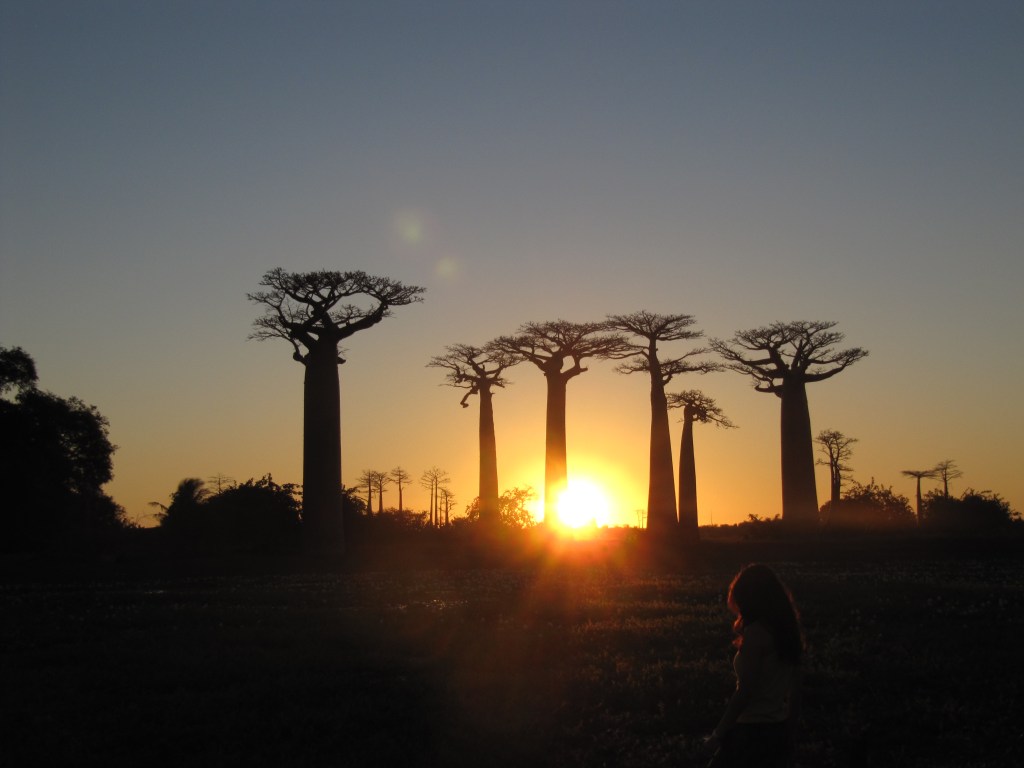
The magnificent baobabs line the road for about a mile. There is also a large grove of baobabs nearby from where we watched the sun set between wonderful trees.
Anadasibe National Park (Perinet Area)
Our last adventure was in the highland rainforest, the Anadsibe National Park in the Perinet area, which is only couple of hours, on paved roads, from the capital, Antananarivo (Tana). The park has a great deal of wildlife. The most amazing experience at the park was hearing the call of the wonderful Indri lemurs. It is an unearthly call and fills the rainforest.
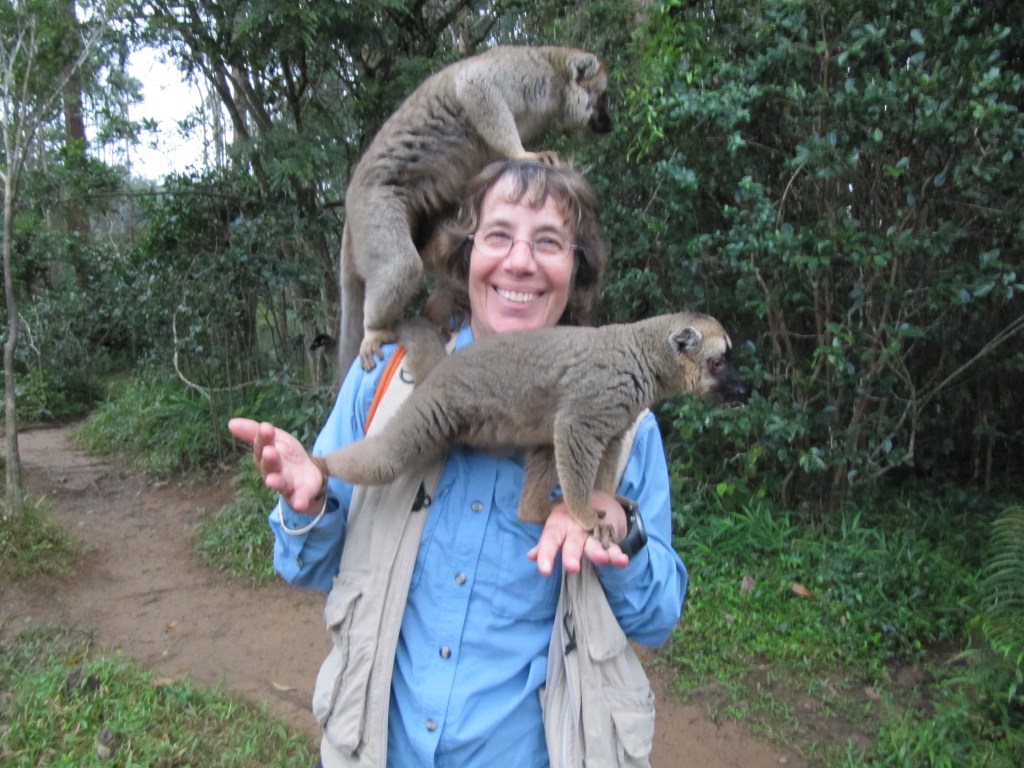
In addition to our walks in the park, we went to the nearby Lemur Island. The island is a refuge for former pet lemurs. They are used to humans and some of them amused themselves by jumping on us.
Antananarivo (Tana)
Anyone visiting in Madagascar will probably visit Tana multiple times. It has the only international airport, and most flights to other Malagasy cities come in and out of its domestic terminal. We stayed at the lovely Pavillon de l’Emyrne each time we were in Tana. The hotel is on a quiet street but is still an easy walk to the shopping areas. It started life as a 1930s style house and has been beautifully restored with a magnificent garden in its courtyard. Each room is unique, roomy and pleasant.
The most interesting sightseeing while in Tana, was the old palace just outside the city, built by king Andrianampoinimerina, who unified the country. This palace is just a one-room house. After a few years there, the king moved his residence to Tana, but his palace is still considered a holy site. He is buried there along with his father and his wives.
Final Comments:
- Having the time and money to go on an extensive trip means really seeing the country and experiencing its treasurers. Most visitors to Madagascar see the capital and maybe, the Perinet area. I am glad that I did not miss our other adventures.
- When going to a country like Madagascar, the traveler has to be flexible and roll with the punches. Changes in schedules, and bumpy rides will definitely occur.
- The land of the lemurs is definitely worth the discomforts. It is a wonderful place to visit.
- Go while you are still in good shape so that climbing the Tsingy and long car rides are possible. Currently, at 80, I do not think I could do this trip.
 Nili's Adventure
Nili, this was a wonderful adventure. Thanks so much for posting it.Marsha
LikeLike
Thanks for reading my posts
LikeLike