
For my next adventure I picked hiking in the Negev (Israeli’s desert), during a March visit to family in Tel-Aviv. This time I hired a guide, Ido, rather than go on an organized trip, for the seven-day camping safari. Ido arranged for the camels and with a camel guide/cook, Tooshey. It was an awesome adventure.
Our starting point, at the edge of the Negev, was a Haan, a big one room tent, which in the old days, acted as a Bedouin guest house where travelers could stay with their animals. The floor was covered with rush mats with lots of Bedouin mattresses for cushions. The camels we used on the desert safari live in the corals belonging to the Haan.
The camels were loaded with everything we would need for our safari: water, wood, sleeping bags, food, clothes and our back packs. Camels are not friendly animals but neither are they mean. Mostly they ignored us. Our guides said that we needed to learn to lead a camel in case of an emergency. My camel did not want to listen to me at all – he wanted to stop and nibble at the brush. I pulled, he ignored me and then when he decided to start off again, I wasn’t expecting it, so I fell – thereby bruising my behind. After that I only led or held a camel when it was absolutely necessary.
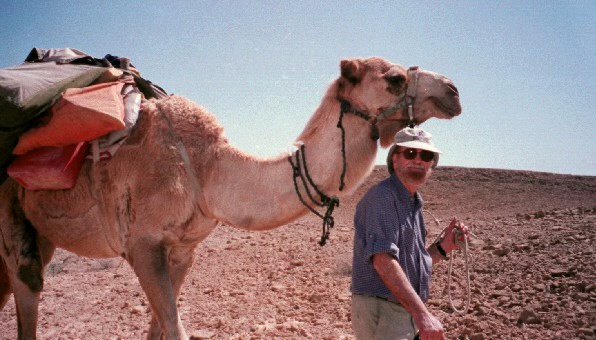
Jerry did just fine leading the camels but most of the time the 3 camels were tied in a caravan and only one person had to lead them.
The pace in the desert was leisurely. We woke up with the sun at about 6 AM, stayed in the sleeping bags a bit more, then dressed. Tooshey (or Jerry) started a fire. At about 7 AM we drank sweet tea (which really tasted sweet to me since at home I drink my tea with no sugar). We washed the dishes from the previous night (it was always too dark after dinner) and then began to cook breakfast. There were vegetables to cut up.
Tooshey made fresh Bedouin pita and usually an omelet. After a few days, Jerry took over making the pita.
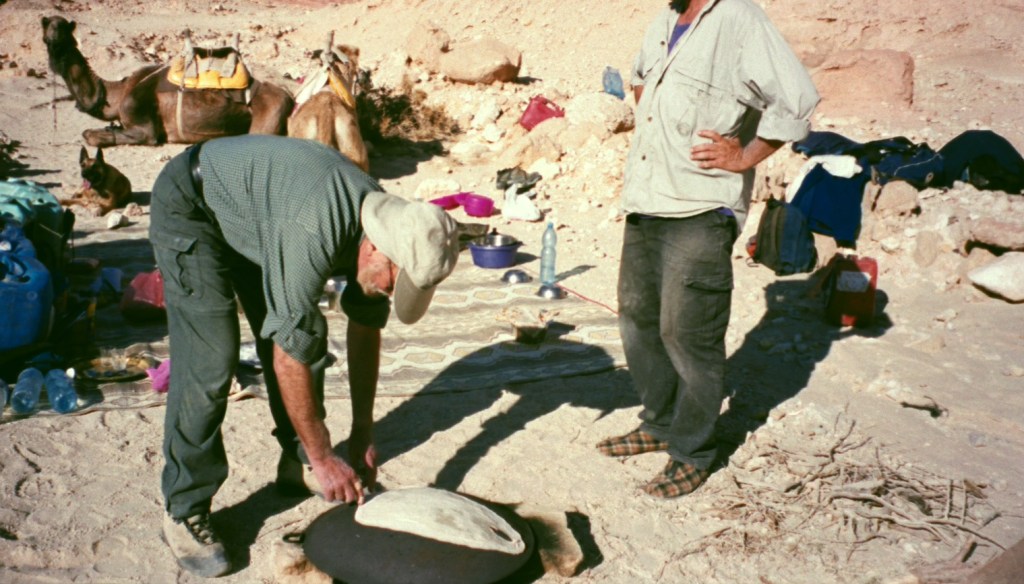
We washed the breakfast dishes and saddled and loaded the camels. We started hiking about 9:30 or 10. We walked until about 1 or 1:30pm when we had lunch of fruit, nuts and pita then walked until about 5 when we set up camp. The morning and afternoon walks did include other rest periods especially for the camels after a hard climb. They were heavily loaded.
When we stopped for the night, Ido and Tooshey looked for a campsite in a Wadi (a dry river bed) with as much protection from the wind as possible, but not with overhanging rocks that could collapse. The camels were unloaded, we found our sleeping spot (as soft as possible) and then started to cook dinner by lantern light. Dinner was also leisurely since we had tea first with some Halvah and then started cooking. The meal was usually a vegetable hearty one pot dish – stew or soup – no meat. We also had cut up vegetables, avocados and humus. By about 8:30 we retreated to our sleeping bags to get warm. In fact, in the high and middle plateau, it was so cold that we used two sleeping bags. We chose not to use the tents so that we could see the stars better.
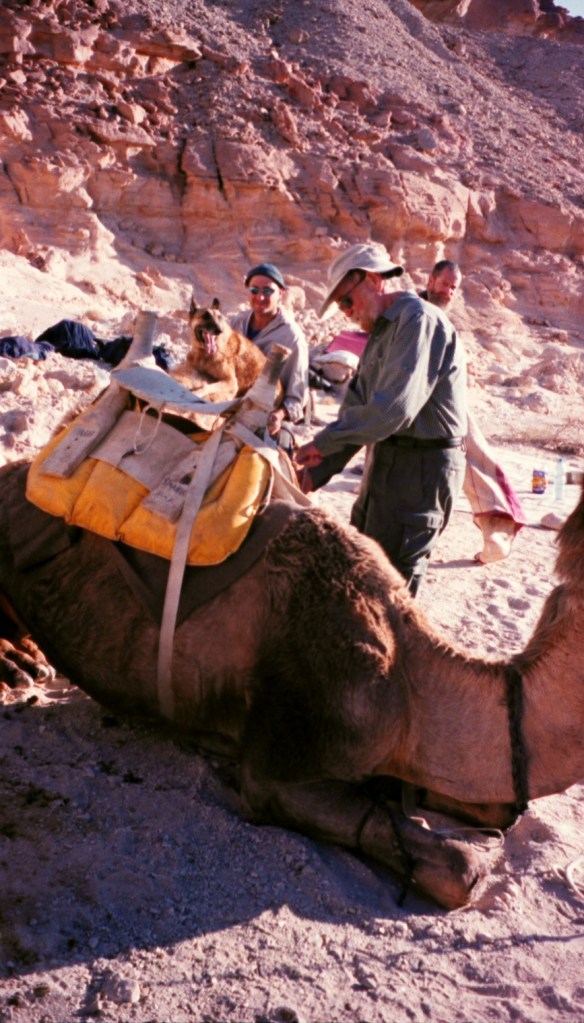
I use the “we” in all of the loading/unloading and cooking descriptions because Jerry and I were expected and were happy to pitch in with the work load. Jerry became quite proficient at saddling the camels. I mostly cut up vegetables, washed dishes and carried stuff from the dining mats to the camels.
What was the hiking like? It usually consisted of narrow mountain trails with lots of ups and downs. The landscape was like much of Nevada or Southern Calif desert – totally barren except for brush now and then and fascinating rock formations. It was very beautiful. At least I think so.
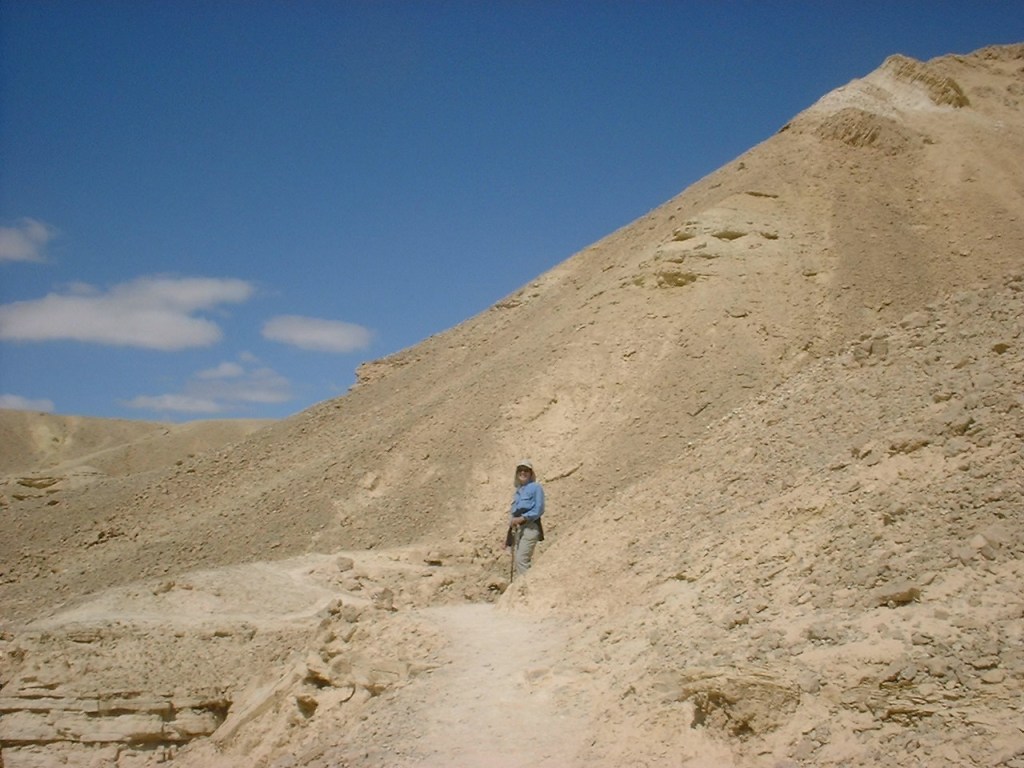
Since we walked along side the camels, we had to carry very little – not even a back pack. I only carried my small camera, a light weight fleece around my waist and my water. We wore and needed hiking boots and used our hiking sticks. This was not an easy hike.
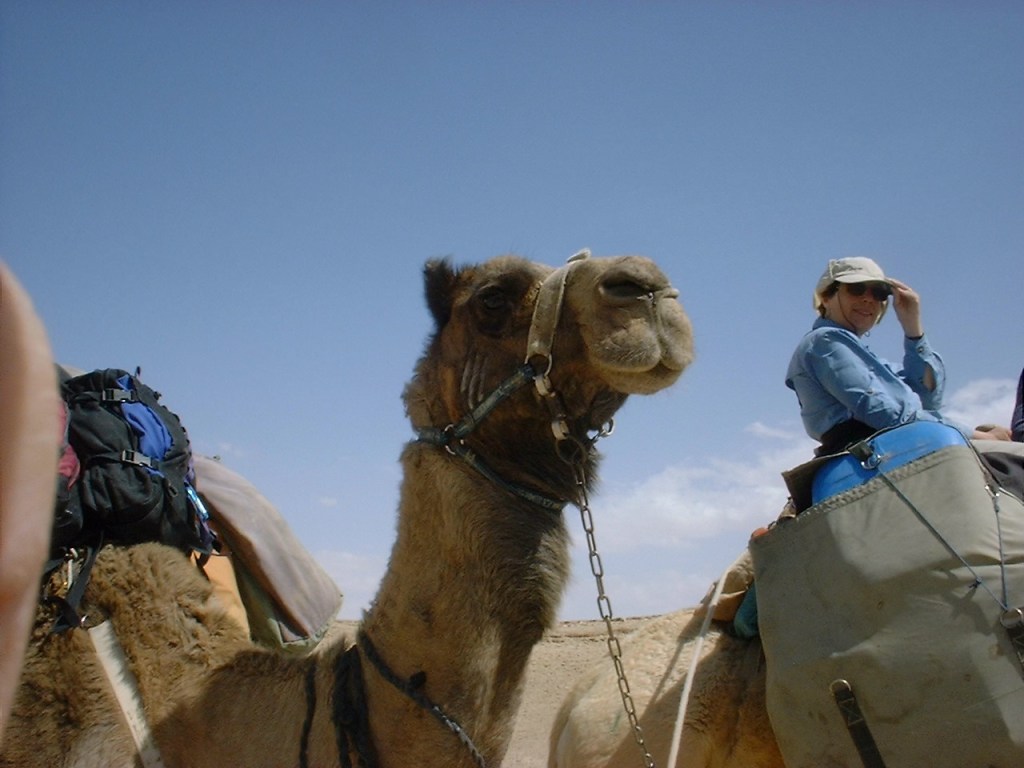
We did ride the camels some of the time (2 hours or so total for me) but I found the walking much more pleasurable.
The weather was incredibly beautiful every day. We were mostly comfortable with just a shirt, but at times needed our light weight fleece especially in the shade when the wind came up. The pace was great and the sights were wonderful but the best was the isolation from civilization. We really became one with the desert. It is hard to describe the feeling of being so isolated. It was magical.
Here are some of the highlights of the actual hikes.
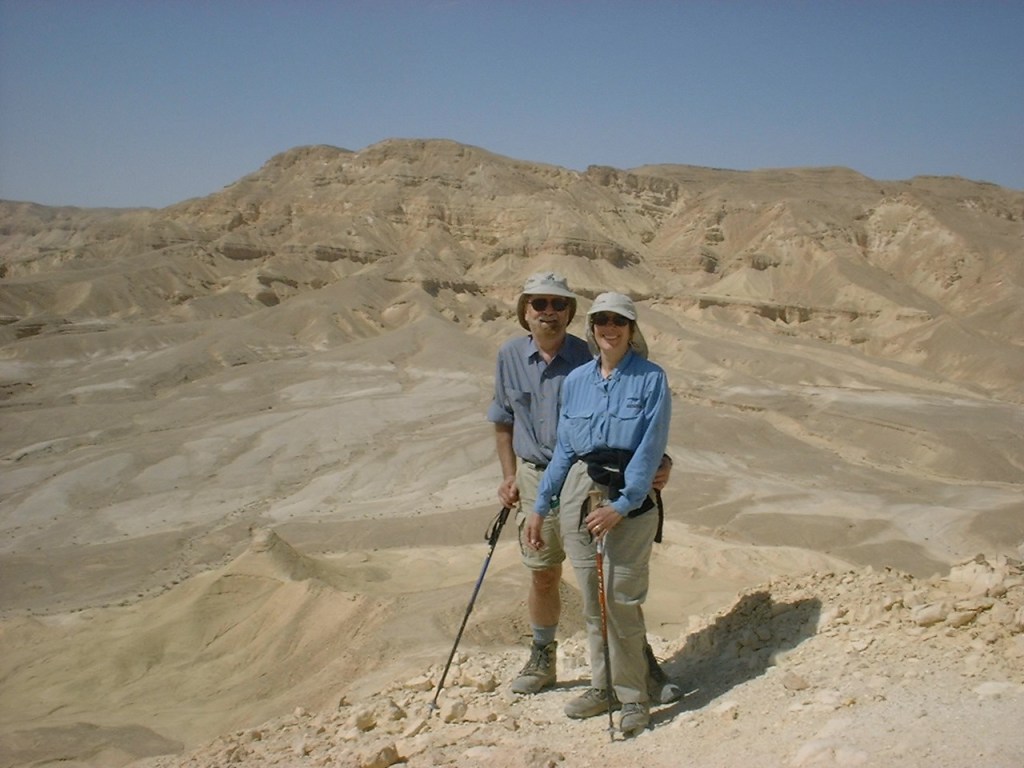
Mt. Argamon: On the second day of the hike, we left the camels to rest while we climbed straight up Mt. Argamon-200 ft in 13 minutes. For a good part of the hike up I was on my hands and knees. And on the way down I mostly slid on my bottom. But it was well worth it because from the top we had a view of the entire valley and the feeling of accomplishment.
Mt. Berach: The climb to the top of Mt. Berach was fairly easy – long but a wide 4-wheel trail and then a short hiking trail. From the top of the mountain, we could see four countries – Israel, Jordan, Egypt and Saudi Arabia. We could also see the Timnah valley with its old and new copper mines.
Timnah Valley: After hiking in the upper and middle plateaus for a number of days, we went down to the Timnah valley. There we saw copper mines, Solomon’s Pillars, remains of an Egyptian temple, cave drawings and the Pink Canyon.
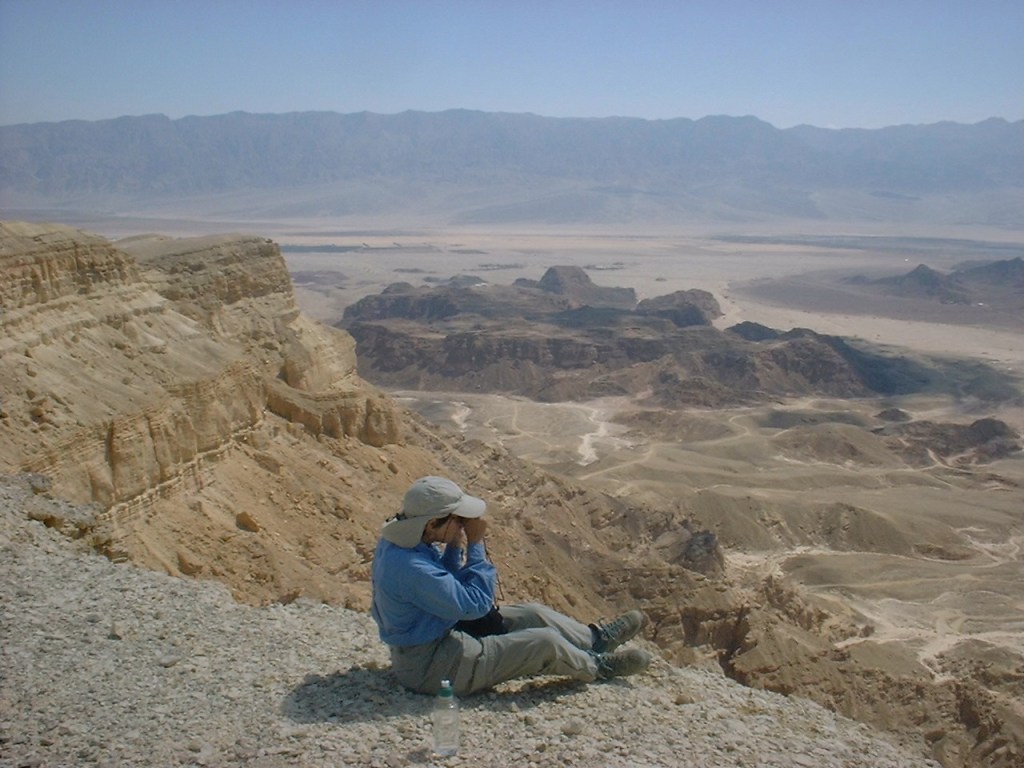
The Copper Mines: were from the chalcolithic period (about 5000 BCE), from the Egyptian period (about 1200 BCE) and from modern times (1950s).
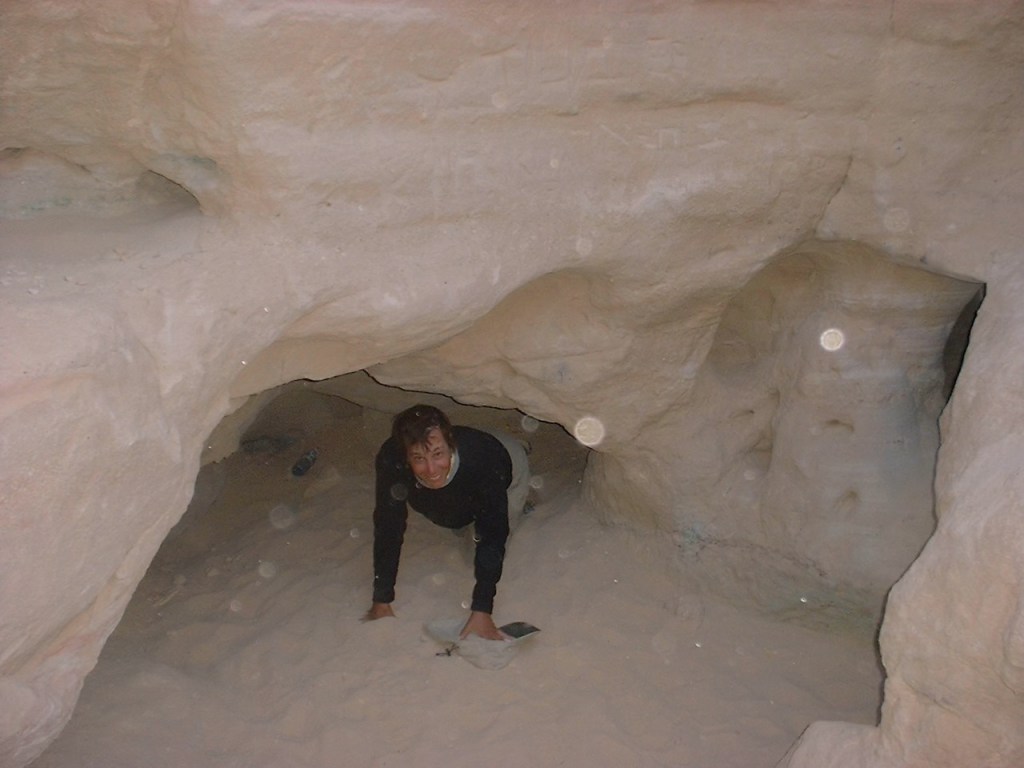
The oldest mines are not very deep and they are open for the public to crawl through. It is just incredible to crawl through them and know that 7,000 years ago other people were working in these mines. The Egyptians, with better knowledge and tools were able to go much deeper and mine more copper that way. There are some 10,000 shafts that they dug. However, the mines from 50 years ago were not cost effective and have been abandoned.
While the Egyptians were in the area, mining copper, they built temples. We visited one temple that has been unearthed near the mines and saw Egyptian rock engravings from the 12 century BCE depicting King Ramses III and the god Hathor.
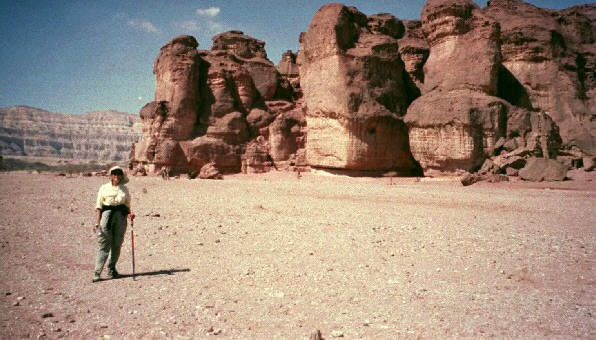
King Solomon’s Pillars: Nature carved out huge pillars in the side of the mountain. They have been named Solomon’s Pillars; however, King Solomon was never in the Timnah valley. The name stuck nevertheless.
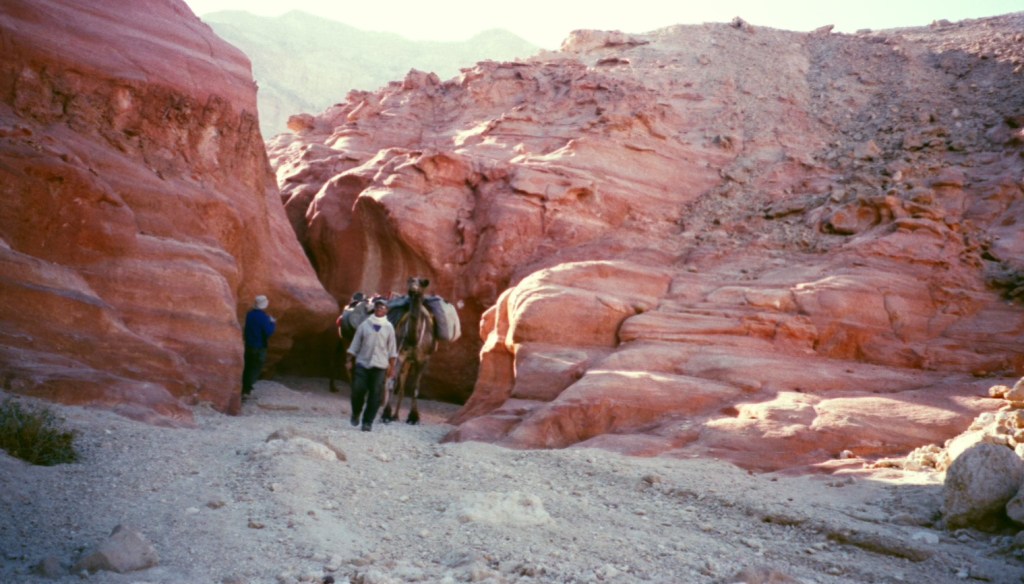
The Pink Canyon: We hiked through this canyon with its marbled pink walls. It looked a lot like Petra, Jordan only on a smaller scale. The opening of the canyon was small and rocky and the camels really resisted going through. At the opening of the canyon there is a cave with Roman inscriptions in it.
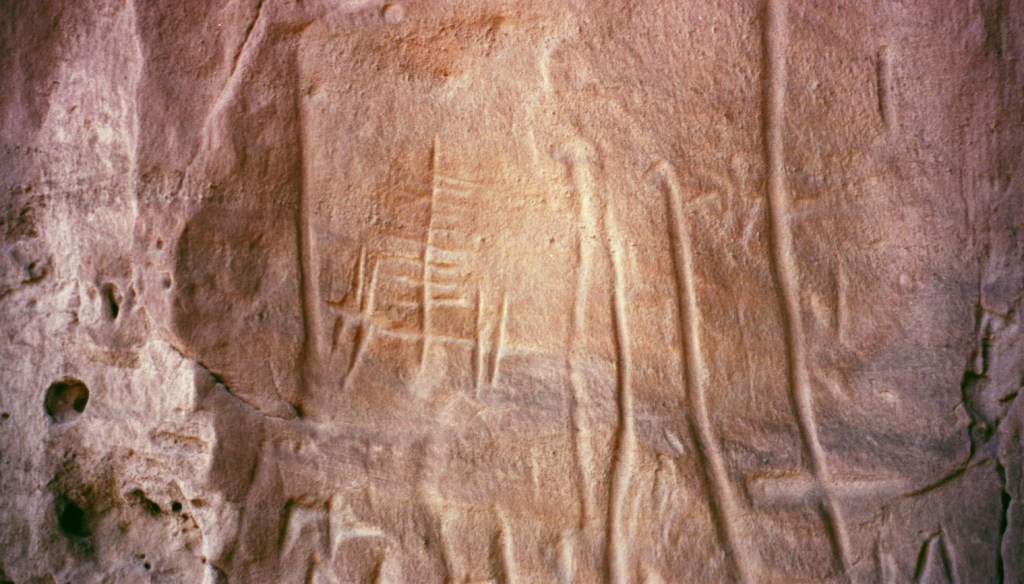
Cave drawings: During one of our lunch breaks, we saw some interesting cave drawings from about 6 or 7 thousand years ago. At another place we saw drawings of an elephant mother and her baby.
Animals: Although there are many animals in the desert, we only saw a few. We saw an Ibex (Yael) and antelopes. Jerry also saw a yellow scorpion. Luckily, I did not. We did see dropping and tracks for lots of other animals.
Life in the Desert: Our two wonderful guides pointed out various plants including the caper plant, Acacia tree with its large thorns and another plant that the Bedouins used as soap. You can rub the plant and with a bit of water, and it froth’s up and becomes like soap. We also saw lots of fossils both on the ground and in the rocks.
The hike ended at the starting Haan. What a wonderful adventure. After the time in the desert, Tel-Aviv felt so full of people and busy. But fun.
Final comments:
- I really enjoyed hiking at my own pace, rather than having to keep up with a group
- A good guide is golden.
Between the Israeli desert and Southern Africa, there were a few trips that I will skip: primarily another trip to visit family in Israel and an England trip focused on the Jane Austen Society meeting in Winchester and Chawton for the Society’s 25th anniversary in 2003.
 Nili's Adventure
What amazing adventures you have had and I’m so happy to read about them. Thanks, Nili!
Sandra Grant
LikeLiked by 1 person
Nili, I think this is the first trip you published in the travel magazine. It’s entirely different from any travel I’ve ever heard of. You and Jerry were so courageous and independent minded. Thank you for sharing your adventure.
Marsha Huff
LikeLike