
It might sound a bit crazy to fly 10 hours south to Santiago and then another 5 hours to the middle of the Pacific Ocean to see a few statues. At least my husband thought so, but he is a good sport and agreed to go.
I already recounted my Chile adventures in post #24. Now it is time for the Easter Island adventure.
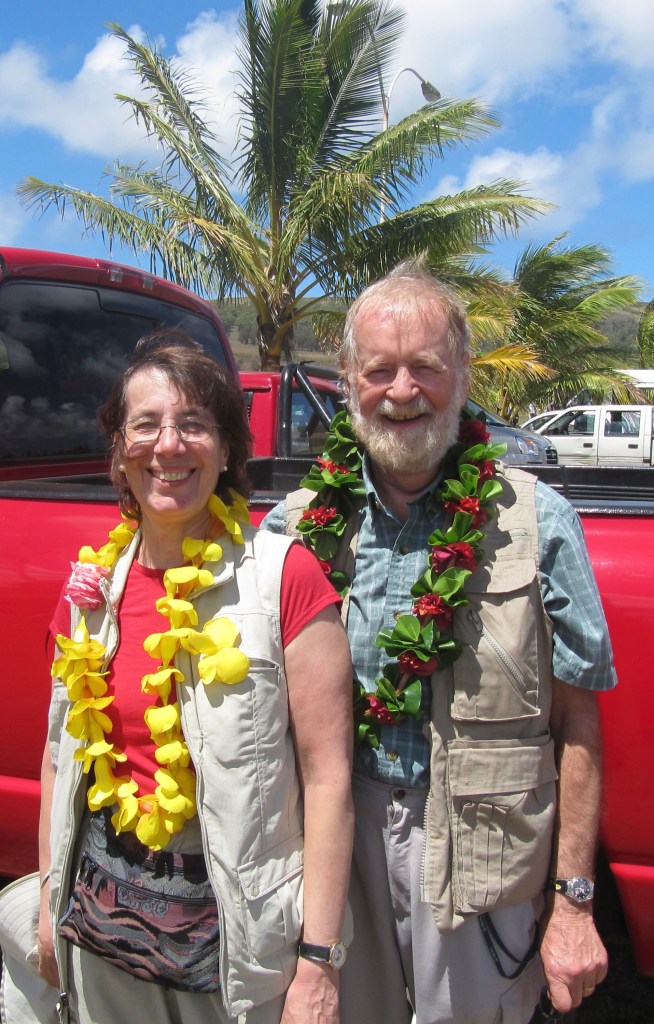
When we landed at the tiny airport, we were greeted by lots of palm trees, warm sunshine and garlands of flowers.
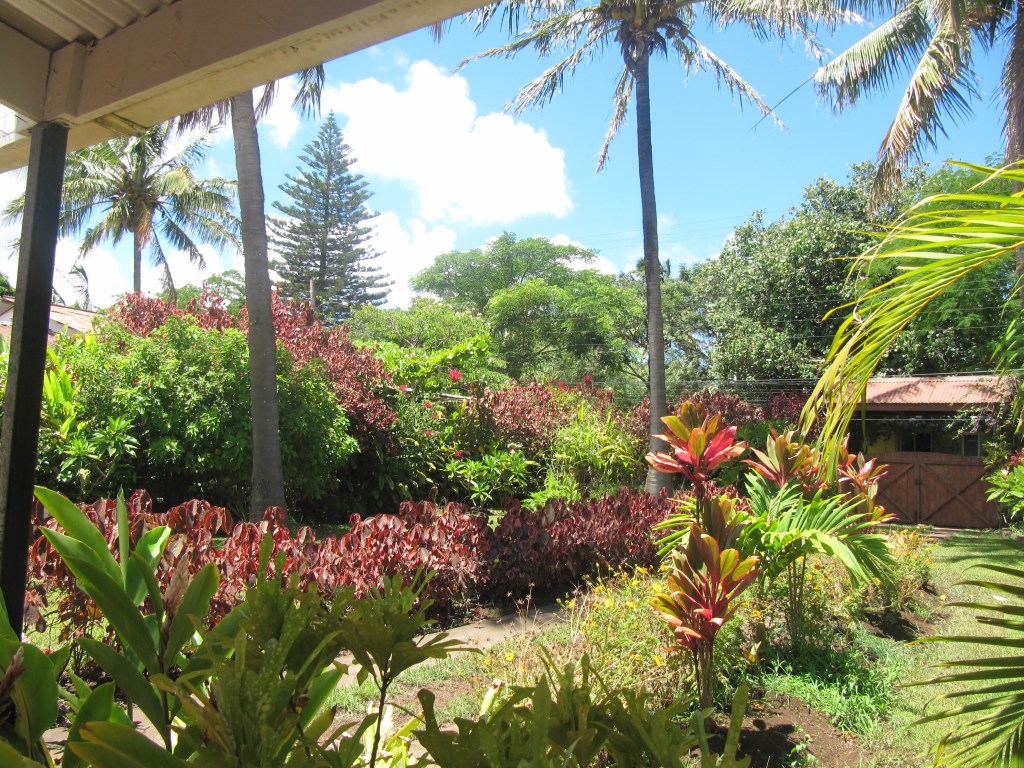
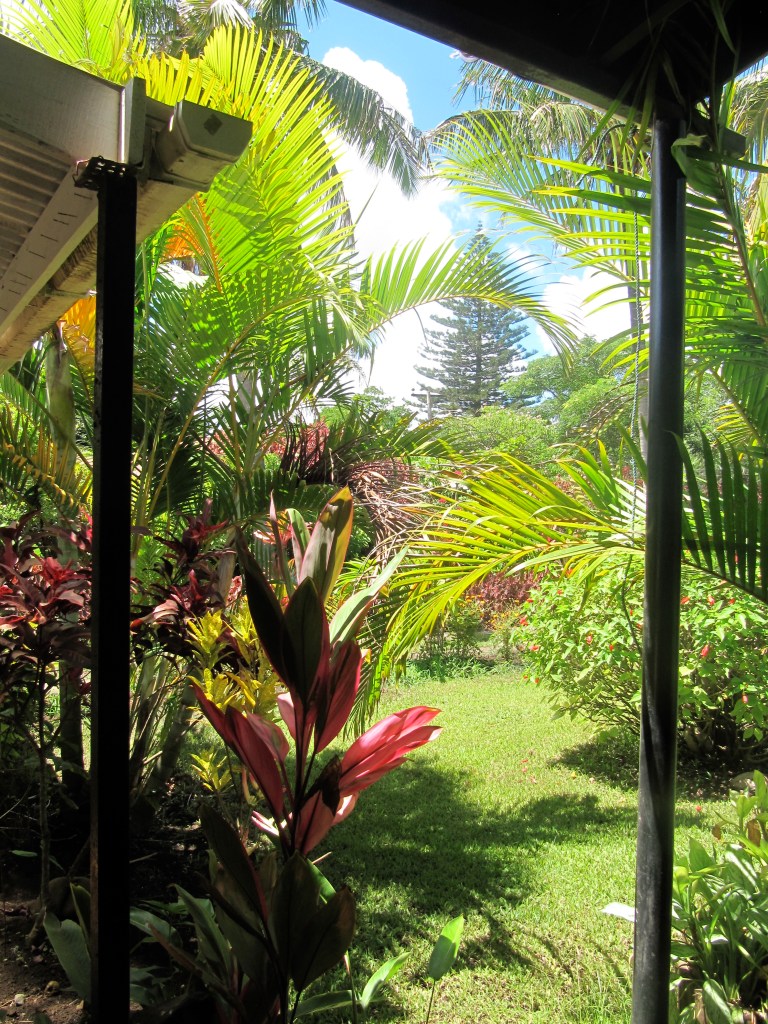
We stayed at the Aloha Noi B&B (above) run by our guides, Ramon and his wife Josie. Ramon was born on the Island and the B&B is the house he grew up in. Josie was born in the U.S. to an Islander dad and an American mother.
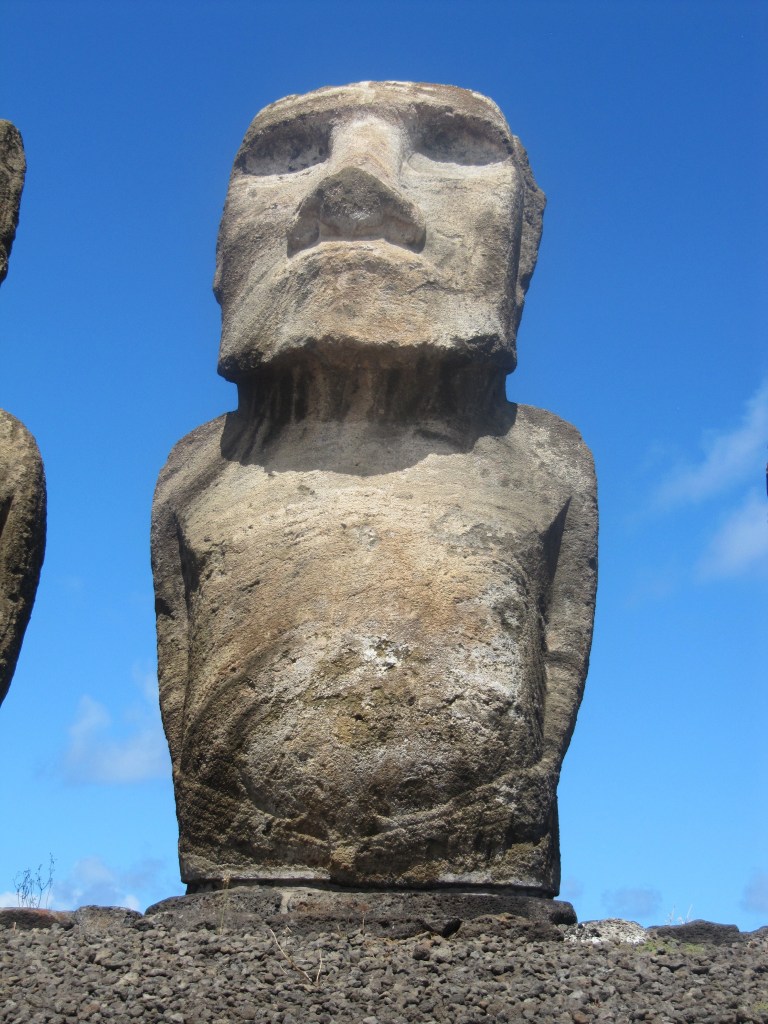
The big attractions of Easter Island are the 900 or so Moai including those that were carved but were never taken to a pedestal. What are Moai? They are statues that were built to represent the ancestors. The Islanders believed that if you pray to the Moai, it will intercede for you with the spirits of your ancestors. The Islanders placed eyes in the Moais for ceremonies then took them out and stored them. We did not see any of the eyes. The Moai always faced the village to watch over it. Many Moais were destroyed before white man ever came to Easter Island. In the local wars, the winner would knock down the Moai of his adversary.
This is not a history book, but a short history, given by our guides, might be helpful in understanding the culture and the importance of the Moai.
1. The Island was settled around 500 CE by Polynesians. There was probably an exploratory visit by able navigators and then a large migration of a entire tribe with its King and social order intact. They would have brought plants and animals with them on their boats. At that time, the Island was covered with trees and was a virtual paradise. But the settlers used the trees and eventually deforested the Island.
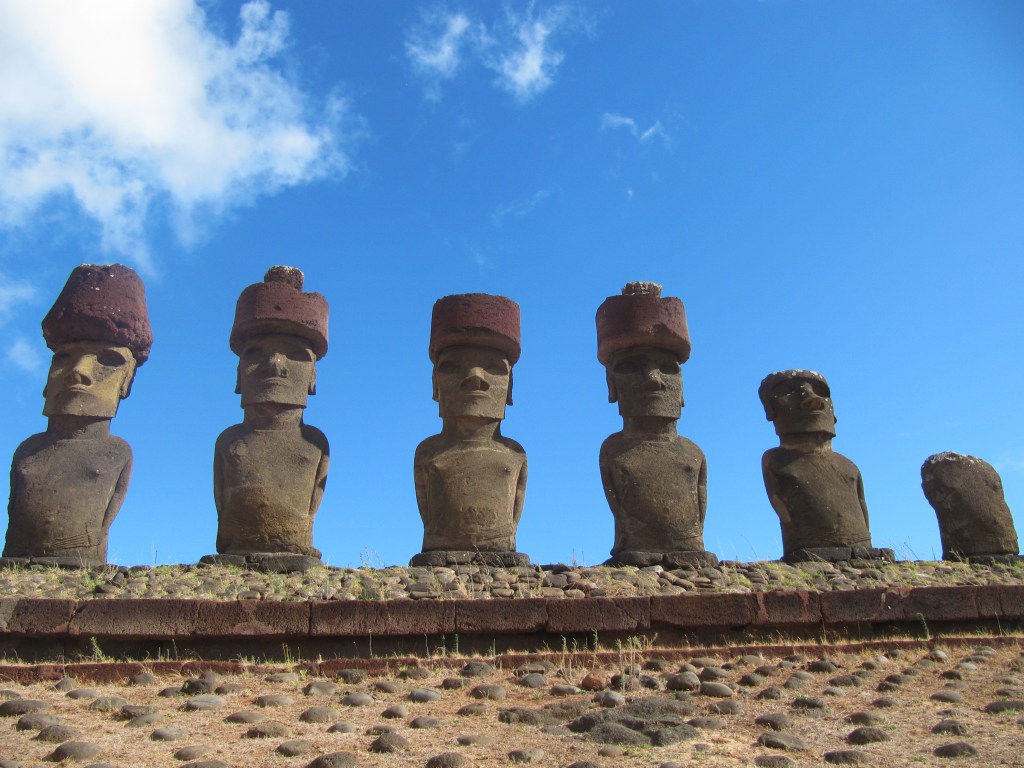
5% of the Moai were carved during this period. They were carved from Basalt and Red Stone. They were smaller than later Moai. The early Moai platforms resemble the platforms in Polynesia.
2. 1000-1500 CE is the main Moai period. About 1,000 Moai were carved during this period.
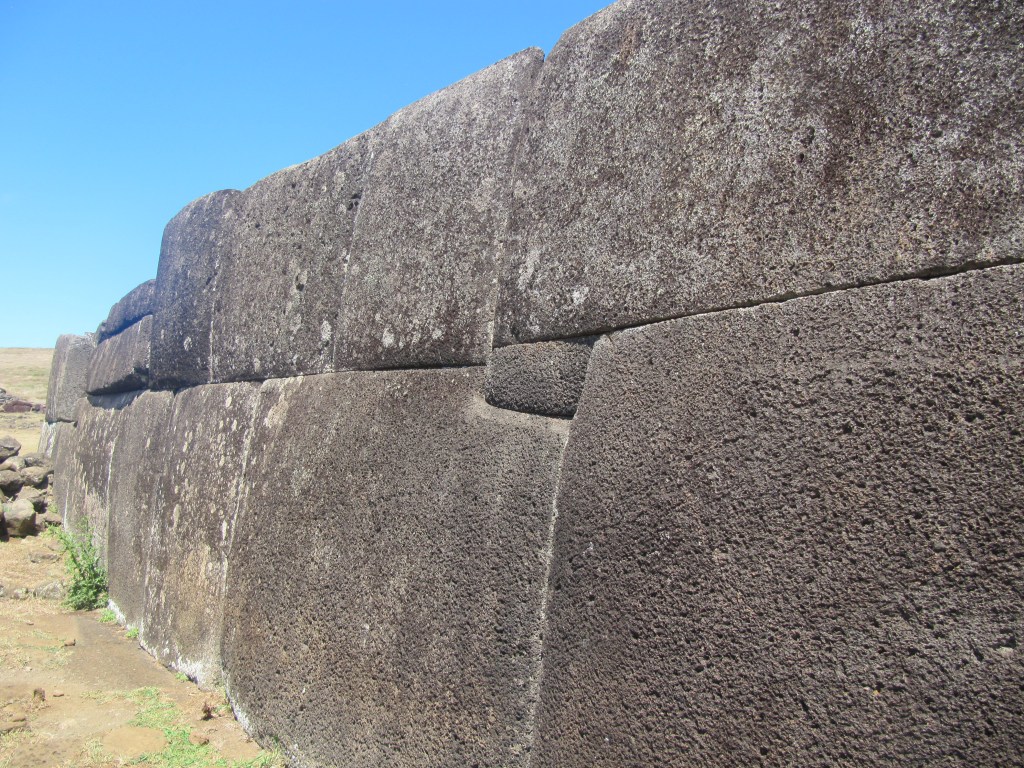
They were brought long distances from the quarries and placed on platforms made from huge stones that fitted perfectly with each other. Not all those carved, were actually erected, mostly because they were not perfect.
3. From 1500 to 1722 is known as the Bird Man Cult period. Because of deforestation, population increases and maybe over fishing, the Island people came upon hard times. They stopped believing in the king. Each one of the 53 tribes tried to get the better of its neighbor. War broke out and the winner would topple over the Moai of the looser often purposely breaking the head.
Instead of ancestor worship, the tribes now worshiped the “Bird Man”. The tribes would decide each year, who would rule for the next year by having a young athlete from each tribe compete. (More about Bird Man later in the post.)
4. Starting in 1722, Easter Island began to have contact with the outer world. This did not go well. Whaling ships brought diseases and kidnapped natives. Then around 1860s, Peruvians took about 2,000 Islanders on slave raids. Between the diseases and slave raids, the Island’s population dropped to 111 people by the 1890s. There are now around 1,000 descendants of those 111 people. But many of the descendants, like Josie, our host/guide, are not pure Polynesian. The total Island population is about 5,000 inhabitants.
In 1889 Chile annexed the Easter Island and limited the Islanders to a small part of the Island, while most of the land was leased to British sheep farmers. Not until 1960, did the Islanders become Chilean citizens and could get a passport. When the US built the shuttle flights’ emergency landing strip, the Island opened up to commercial flights and tourism.
Back to our sightseeing:
I will only mention the most impressive Moai sites we visited, because there were many and it would be tiresome to give a travel log.
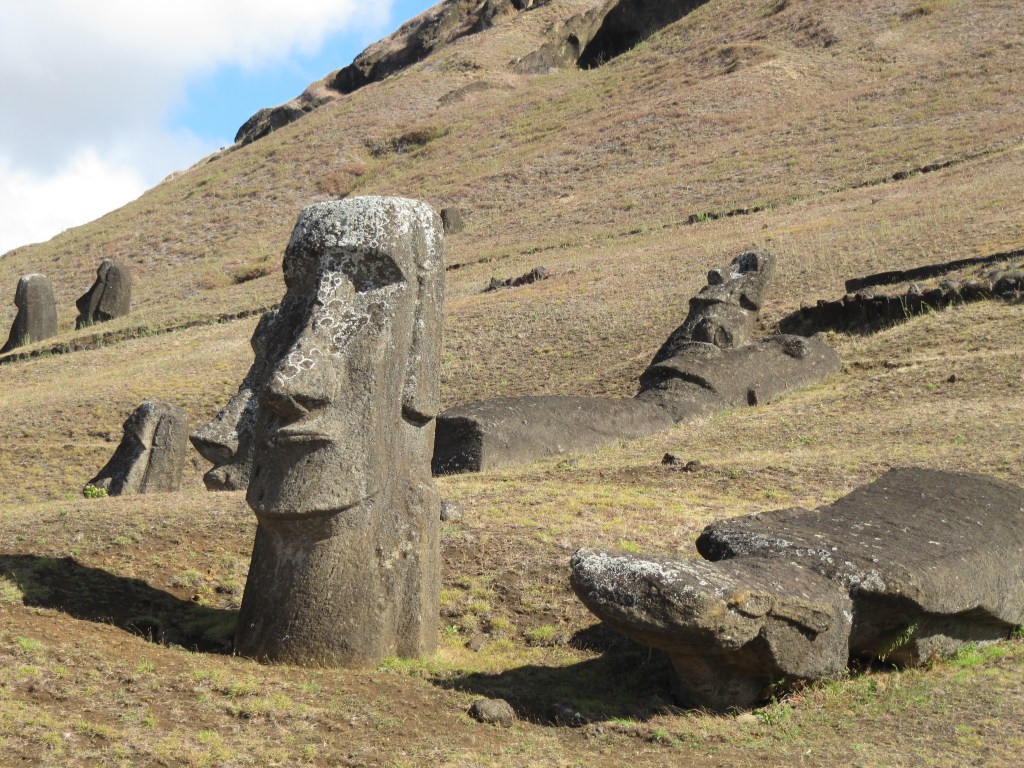
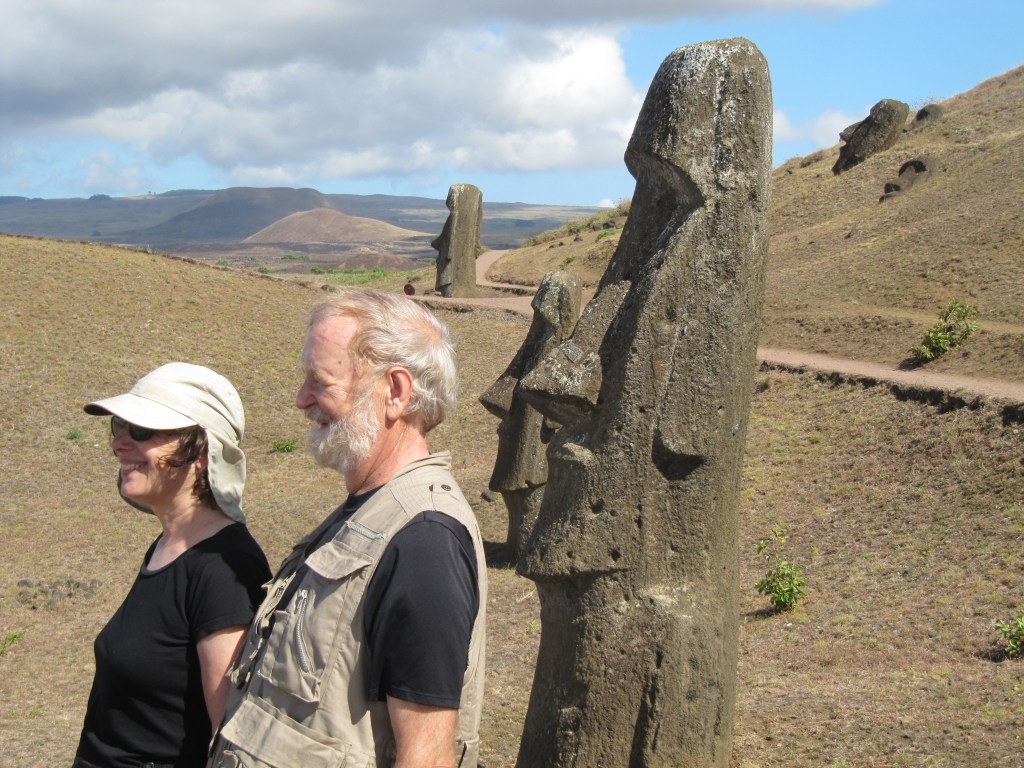
The Quarry, which is a national park, is where most of the Moai began life. Some of the Moai in the quarry seem absolutely perfect and no one knows why they didn’t make it to their destination. Could be that the late Moais were just too big to transport (60 feet high and weighing 200 tons.) Or it could be that they were carved at the end of the peaceful era and were ready to move when the country fell into war and the Bird Man religion took over from the Ancestor worship religion. In any case there are at least 400 Moai in the quarry in varying degrees of readiness. There may be many more because some might be buried under the ground. It was very interesting to see the Moai in their various stages of carving.
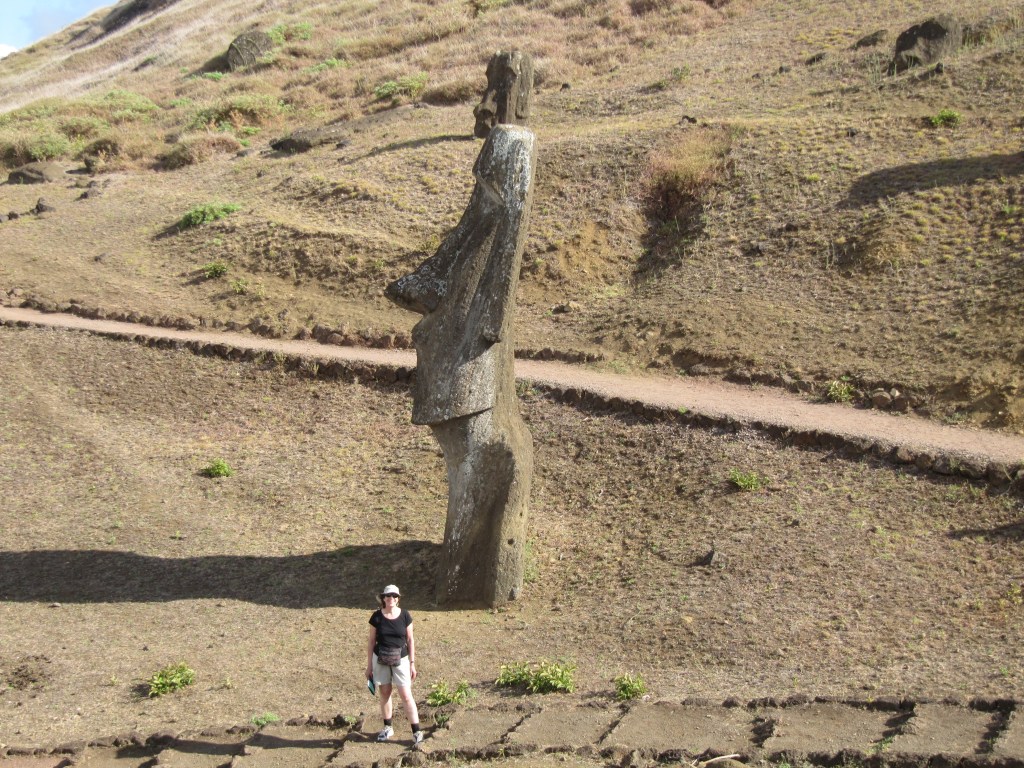
We walked up and down the trails. In some cases, we could get really close to the statues and could get the feel for just high and large they were. That speck in front of the Moai is me. This will give you a feel for their massiveness.
It is not known how the Moai were transported to their final destination, but there is agreement on how they made it from the side of the mountain to where they would start their travels. The Moai were carved in place, in the mountain. A pit would be dug, then the back of the Moai would be carved away from the mountain, and then it would slide to the pit. Keep in mind that these Moai are enormous and the workers had no cranes or power tools.
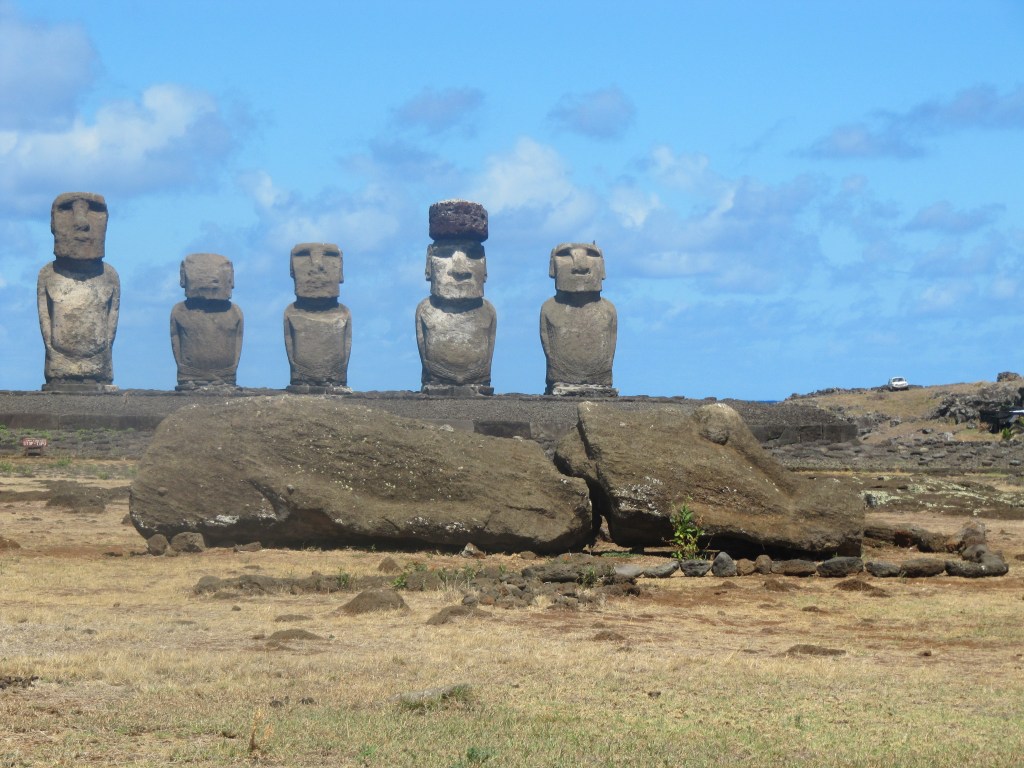
One of the wonderful sites was Ahu Tahira, with 5 Moai on an amazing platform made from very large stones – the kind that were used in Peruvian structures like Machu Picchu. (This is why some thought that Easter Islanders came from Peru.) The blocks fit perfectly and the engineering was amazing. There were fallen Moai behind the platform and the guessing is that after a time, when new ones were carved, the old ones were taken off and left behind. There were top-knots on the ground. These top-knots came from a different quarry, and were brought unfinished to the sites and then fitted to the head of the Moai. They are from a very different type of stone.
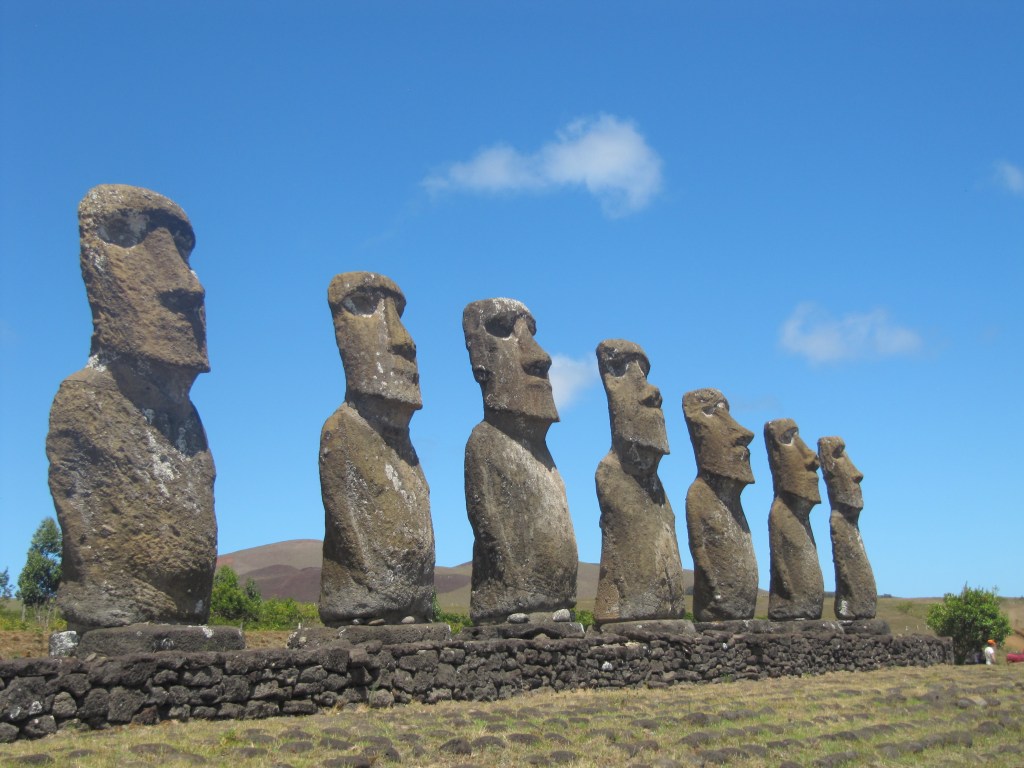
Another fabulous site was Ahu A Khivi. This is the site of the 7 Moai that are on all the postcards and literature on Easter Island. It is the only site where the Moai face the ocean instead of away from it. However, the settlement was between the ocean and the Moai, therefore the statues are actually looking at the village not the ocean.
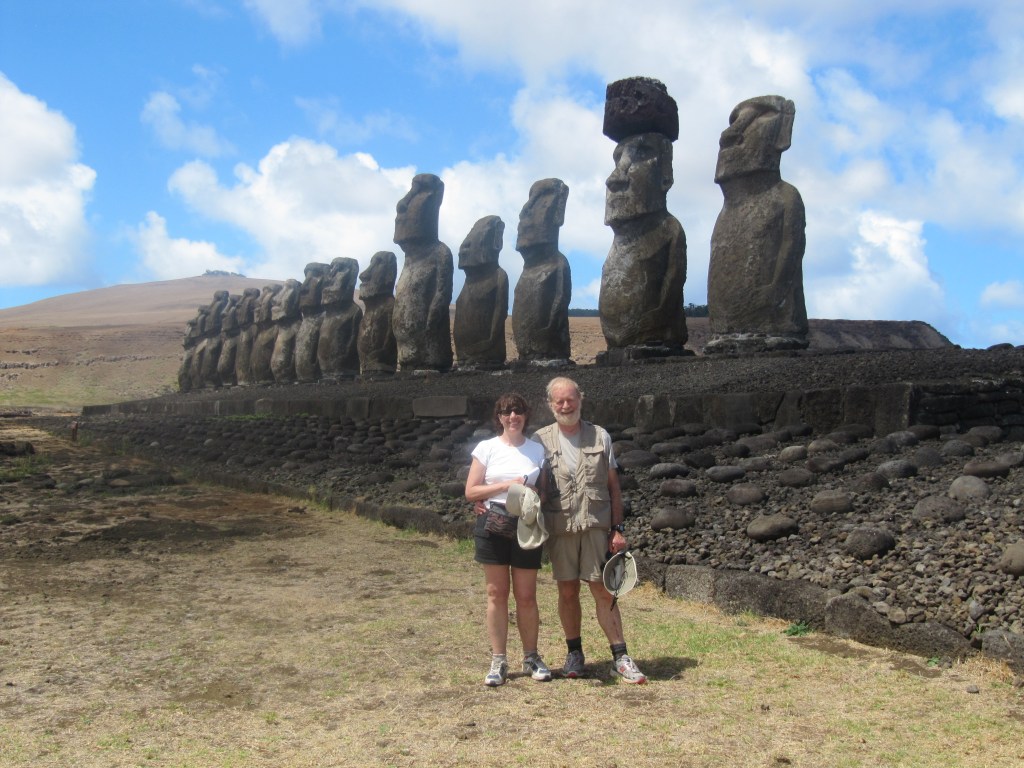
The amazing site, Ahu Tongariki, had 15 Moai standing on the Ahu. One beautiful Moai stood off by itself to the side. It had gone to Osaka for the 1983 World Expo. Finally, at Ahu Te Pito Kura site we saw the highest Moai. It is 10 meters high and weighs 80 tons.
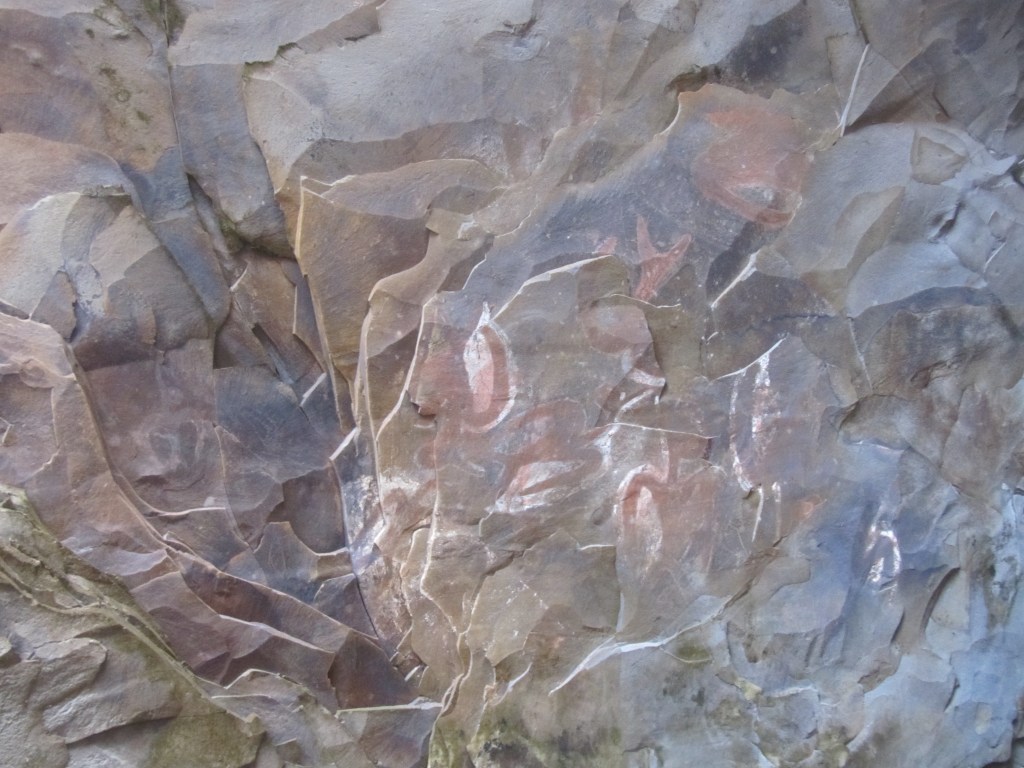
There were plenty of non-Moai attractions, which included the Ana Kai Tangata cave on the ocean. This slate cave (above) has paintings of birds on its walls from the 1600s. The paint was taken from clay (white and red) mixed with the sap of sugar cane to act as glue. Ana Kai Tangata literally means Cave Eat Man. But it was not a cannibalism site – it was a ceremonial eating place used before going up to the sacred place in the mountain.
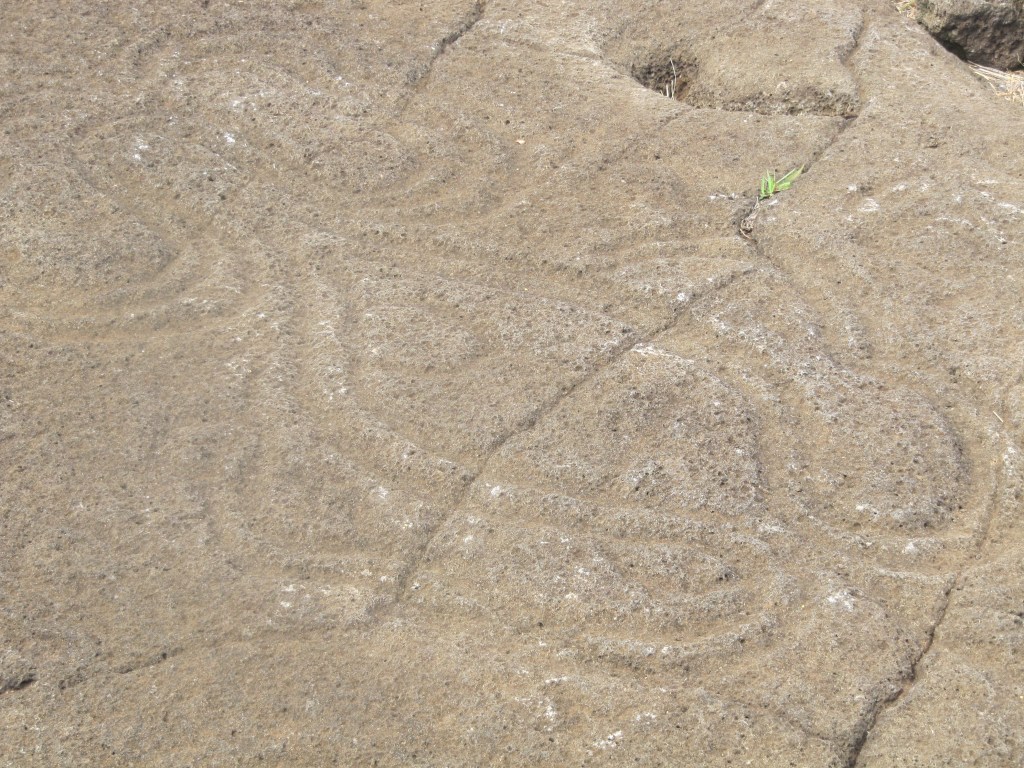
Also of interest are the petroglyphs at Papa Vak. The Easter Islanders did have a pictorial language; however, it has not been deciphered. I presume there are just not enough samples. Unfortunately, the petroglyphs have not weathered well and were very hard to see. We were able to recognize fishhooks, a tuna fish and a turtle (with Ramon’s help).
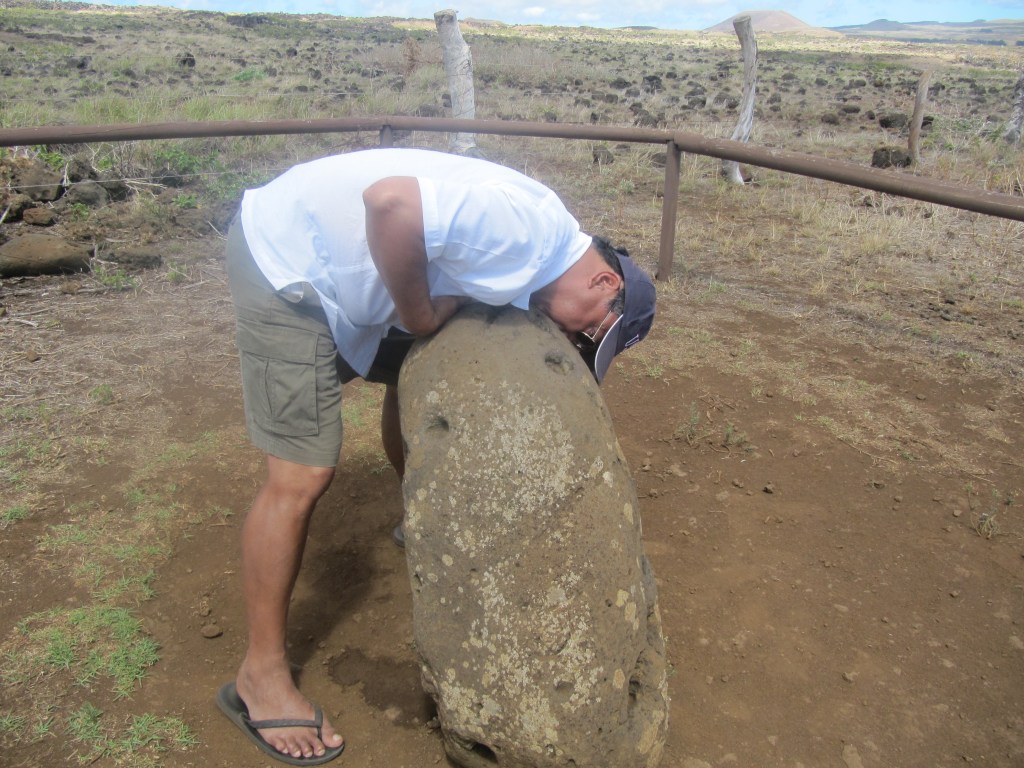
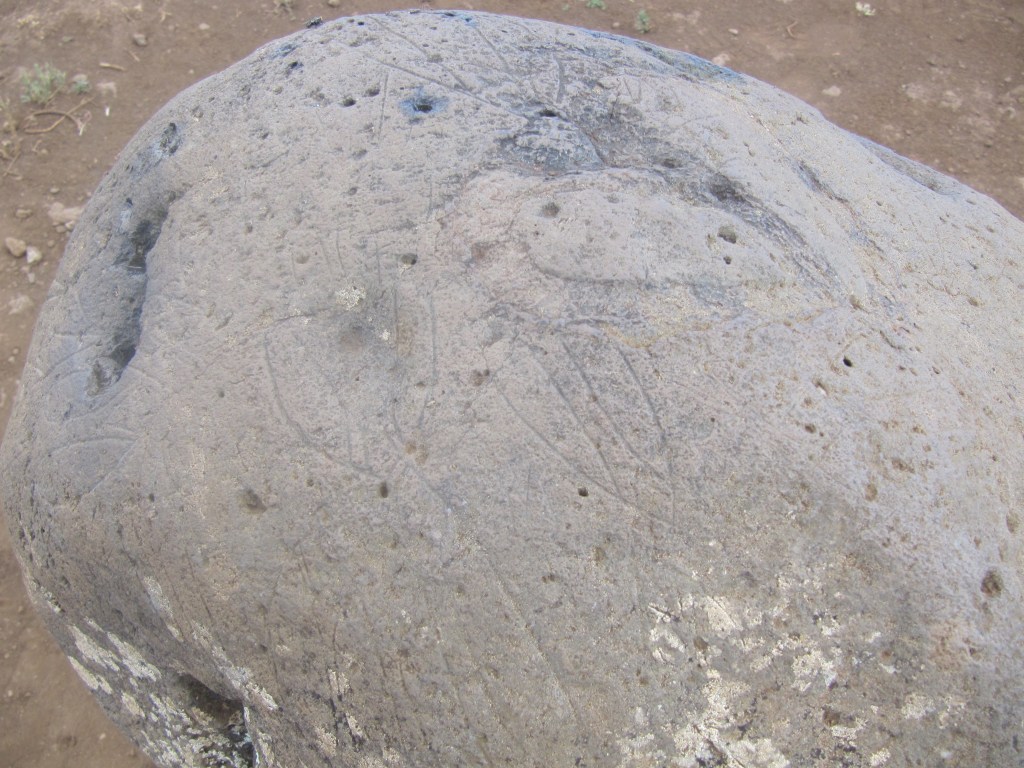
We also saw a rock that was hollow inside. Ramon blew on it and made a sound like blowing a ram’s horn. The rock had fertility markings on it. It was near a house where young girls would go for their initiation rites. They would stay in the house for a few months in the dark so that their skin would whiten and then come out to find a husband.
Easter Island was created by three volcanoes (now dormant).
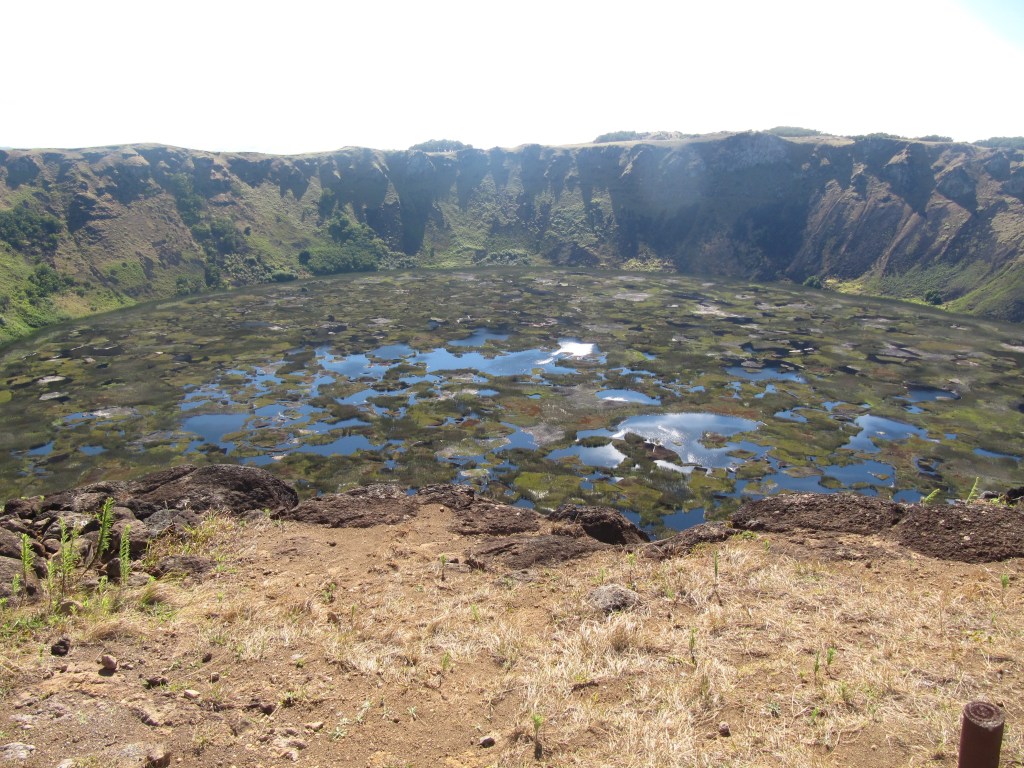
We visited the Rano Kai Volcano basin. It was amazing to look into volcano basin, which is about a kilometer and a half in diameter. Rainwater has created a small lake with lots of fruit trees growing along its 200-meter high banks.
Near the crater, in the town of Orongo, the highest point, is where the Bird Man ceremony took place. 3 islands are visible from the top of the hill. One is actually just a huge rock (perpendicular island), one a fairly small island and a larger island.
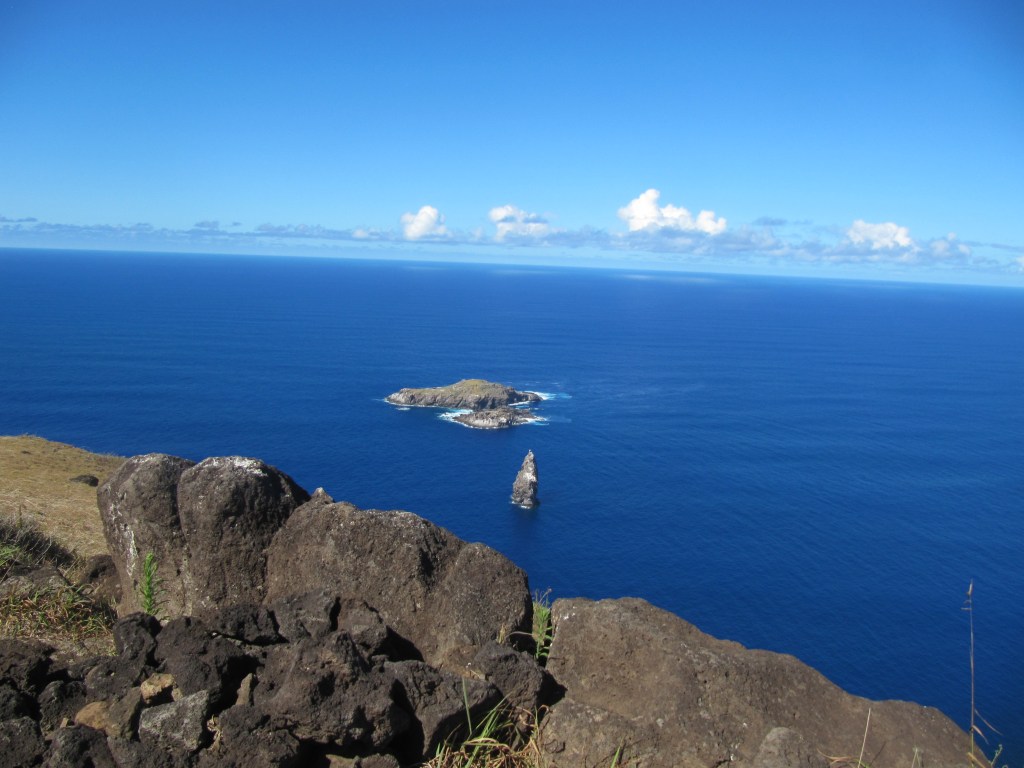
Once a year, birds come to build their nests on the larger island. The Bird Man athletes had to swim to the island, about 1 mile off shore, to get an egg. The first tribe whose athlete got the egg back, was the ruling tribe. The last ceremony was held as recently as 1867.
History really came alive for me seeing where the athletes had to swim to retrieve the egg. Sometimes they had to spend a few days on the little island until the birds laid their eggs. Nearby on the hilltop there were many slate dwellings where the athletes lived while getting ready for the competition.
A Day at the Beach
Needing a break from sightseeing, we went on our own, by taxi, to the sandy beach on the island where the king’s family used to live. Our host lent us chairs and towels and we spent about 4 hours at the beach – it was delightful. It was Saturday therefore, there were lots of families picnicking in the grass area and playing on the beach. It was not crowded but it was lively. I went swimming and the water felt wonderful. The air was warm but with a breeze. In addition, we saw a beautiful Moai, which was erected for the king. It was right on the beach. It was great to take a morning off from touring and relax. This is very important to do when doing intensive sightseeing.
A word about horses: They are all allowed to roam free over the island. They belong to someone, but they are allowed open grazing. Unfortunately, this has two draw backs: they graze at and might destroy the archaeological sites and they walk around town and leave their droppings everywhere. Dogs also run free in town and they chase the horses. This is actually pretty funny to watch. I think this allowing the horses and dogs run free is a reaction to the natives being herded in the first part of the 20th century into a small section of the island.
Final Comments:
- Five days gave us adequate time to really experience Easter Island.
- There is more to Easter Island than just the Moai. Well worth the trip!
- Beware of being asked to carry packages. At the check-in counter, at the airport, going to Easter Island, a young woman stood to the side as we checked in. She had a Styrofoam cooler all taped up next to her. When we were almost done she asked (in Spanish) for help. We thought she needed help in picking up her cooler, but the airline person checking us in said that this woman wanted us to check in her cooler since she is over in weight allowance and we are under. However, the airline would take no responsibility for the cooler. We have been drilled by security to never accept a package from someone who we don’t know, therefore we declined. For all we knew it could have had drugs or a bomb in it. The young lady looked sweet and innocent, but I am glad we did not help her out.
 Nili's Adventure
Hi Nili,
I went with Galapagos Travel to Rapa Nui last year so I really enjoyed reading the account of your trip.
One thing that I wanted to call to your attention. It is no longer believed that there was cannibalism on the island. Apparently the myth began when the artist on one of the early explorer ships drew a picture of the Rapa Nui people looking beast-like and gnawing on bones with skeleton heads scattered around. Recent archeologists found some rat teeth marks on bones but nothing that indicated humans eating humans.
Love your stories!
Did you do our Tanzania Africa trip yet? Did I miss it?
LikeLike
You did not miss it. We went in 2019, I think. Thanks for the correction. I will fix my post.
LikeLike