
Bolivia/ Peru December, 2000
I came home from New Zealand full of zeal for my next trip. Up until this time I had confined my travels mostly to the western world. Now I was eager for more adventure and to learn about other cultures. My niece Daphne suggested Peru and specifically the Inca Trail Trek to Machu Picchu. Although I had been comfortable planning and traveling independently in Europe and New Zealand, I felt that I needed to go on a tour in order to visit Peru. A bit of research brought me to Elder Treks’ trip to Bolivia and Peru. Elder Treks is a company that specializes in active, small, (12 or under people) senior trips. At age 80 I could probably not handle their active trips, but at 56, I was ready to immerse myself and learn about the history and cultures of these two countries.
Bolivia
We flew into La Paz, Bolivia, the highest capital city at 11,975 feet, with its airport at slightly higher. It is one thing to gradually climb to a high altitude, it is another to land and walk off a plane this high. Luckily, my doctor gave me altitude pills, which prevented the headache, I would have otherwise had.
Immediately, on my first walk around town, I was enchanted. Most of the women wore very wide beautiful silk skirts with numerous petticoats under them. At first, it looked like the front and back of the skirts were of different materials, then I realized that the apron covered the front of the skirt. While wearing these beautiful skirts, they sit in the dust to sell their wares. They also wear beautiful shawls and funny bowler hats. These hats are worn sideways if the women are single and straight if they are married. However, some of the younger women were in western clothes.
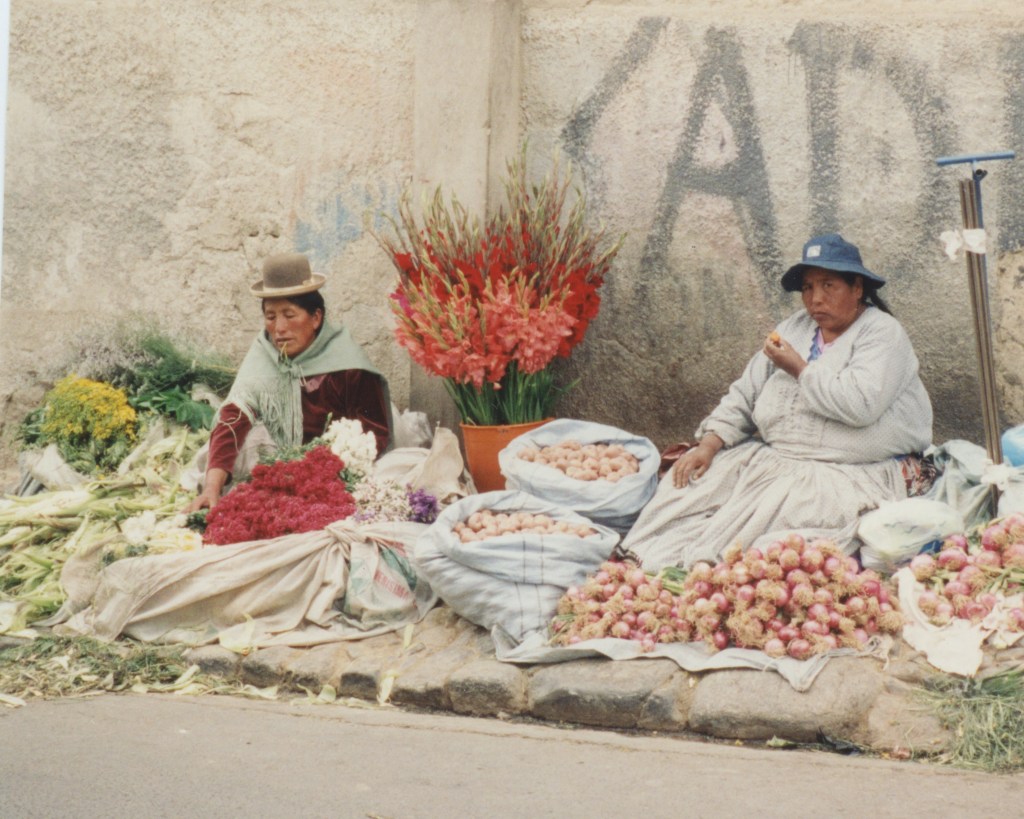
As I walked I saw street vendors displaying their vegetables and house wares right on the street. The eggs sat in large batches in the sun for hours, and there were hundreds of types of potatoes and corn. The potatoes were colorful and apparently grow at different altitudes. So different from our limited selections back home.
Although the area around La Paz is rich in ancient Indian ruins, I will only describe the archaeological site which was home to the Tiwanaku Indians. They lived from about 2400 BCE to around the time of Jesus. The area has only been partially excavated and includes a pyramid and its surrounding structures. One area has lots of carved faces, which might be faces of friends or foes.
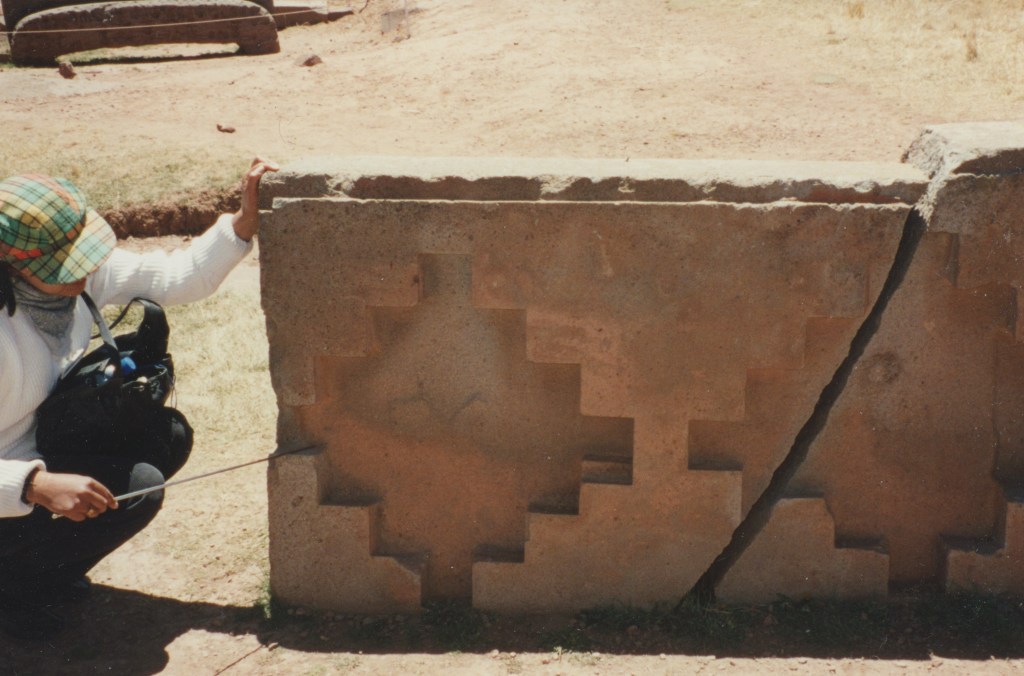
To the left is the Andean cross, which is four sided for the 4 elements – Earth, Wind, Fire and Water. It has 3 levels – the top for the Condor – heaven, then Puma for the Earth and the Snake for the underworld. It is interesting that in their mythology, the snake is also the trouble maker.
In the museum we saw baskets of the dead buried in a fetal position. They were buried like this so that they could be re born from the fetal position. There were almost no other tourists at the site, which made it more atmospheric and we could walk around undisturbed.
Peru
Taquile
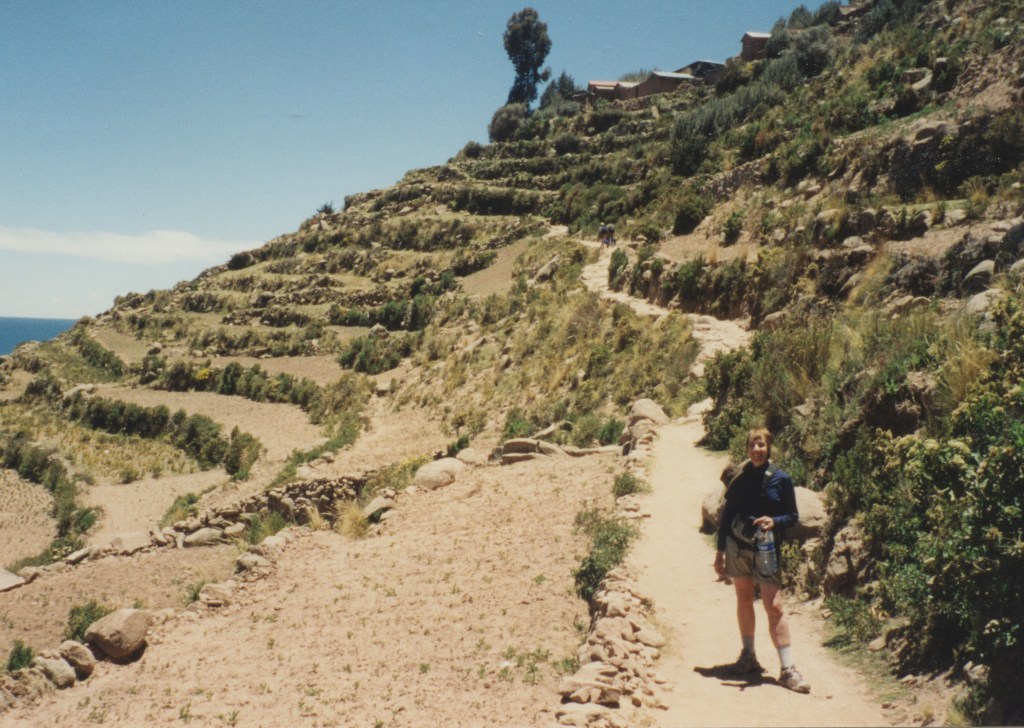
Taquile is an island in the middle of beautiful Lake Titicaca. It’s elevation is 900 feet from the lake shore to the top of the island, and it is at 13,000 to 14,000 feet above sea level.
There are no cars, mules or any means of transportation except feet on the island. The natives walk up and down in bare feet or in sandals, but for us it was hard walking uphill even in hiking shoes because of the altitude. We hiked to the top of the island, saw their temple and burial grounds. The views were spectacular.
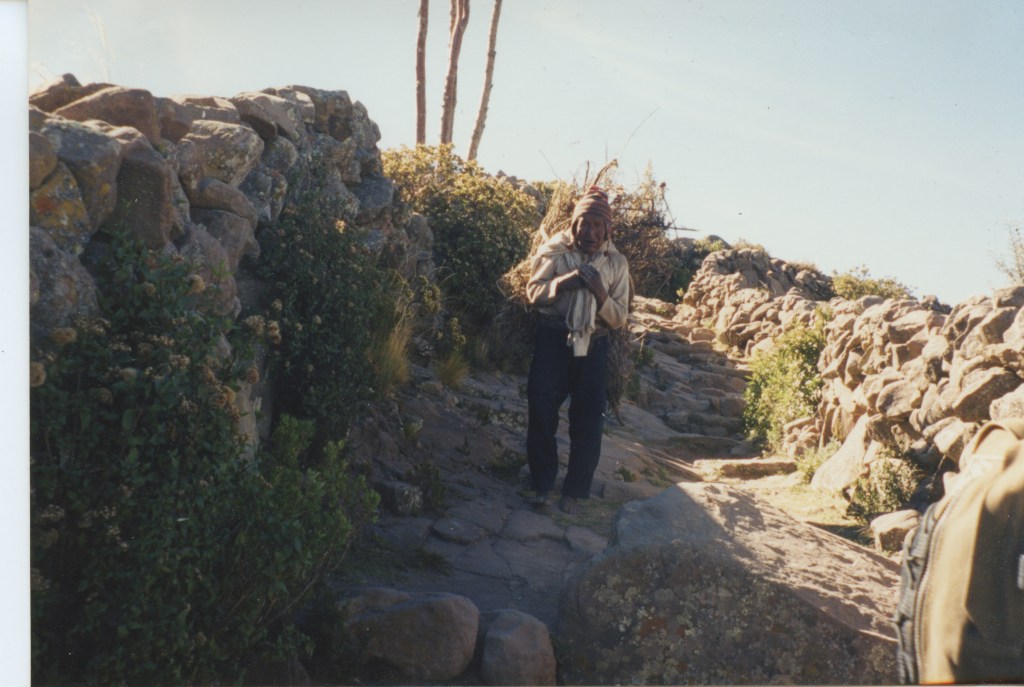
The women all weave and spin as they walk. The men all knit as they walk. They wear red and white caps while single and red only when they are married. The women wear red skirts and tops and black shawls.
We stayed with a family in their mud brick house with electricity but no running water (there was no running water in the island).
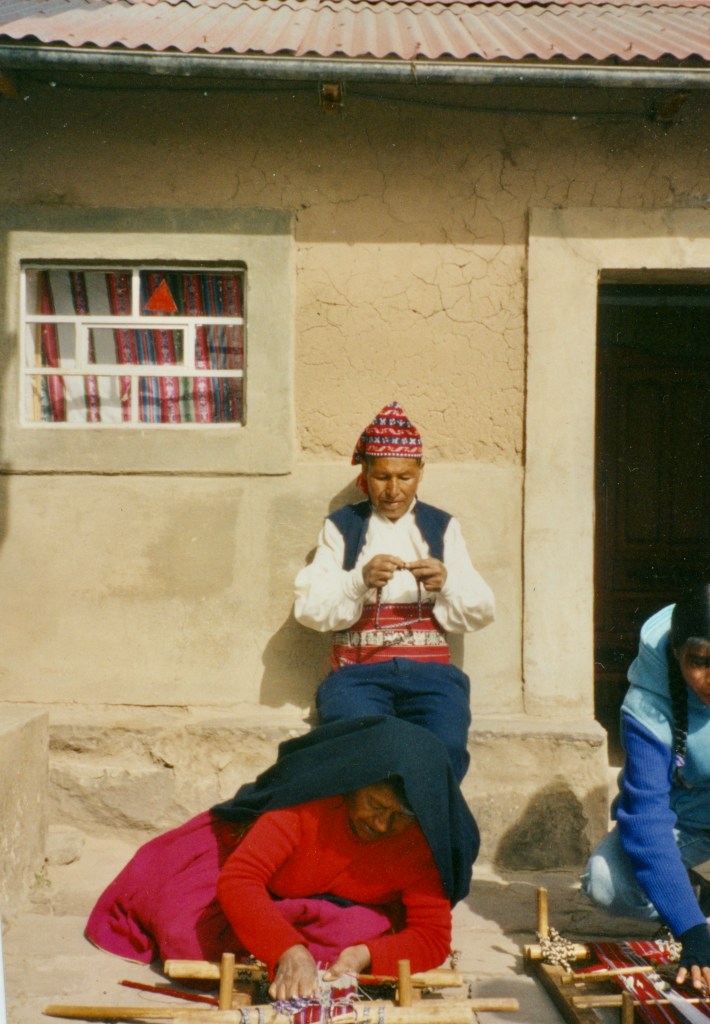
Our hosts gave us a weaving demonstration then gave us an opportunity to purchase some of the items. We also bought weavings from the cooperative. These items are unique and I enjoyed mine for many years. Bringing back unique artifacts from travel spots is one of the pleasures of travel.
The people on Taquile are very democratic: the governors are elected for set terms. It is an honor to be a governor, for instance they walk into church first. It is also a very cooperative place. If one resident needs to build something, everyone helps. They all work on community projects together.
Uros Floating Island:
These islands are also on Lake Titicaca but nearer the shore. Who are the Uros and why did they build floating islands on the lake?
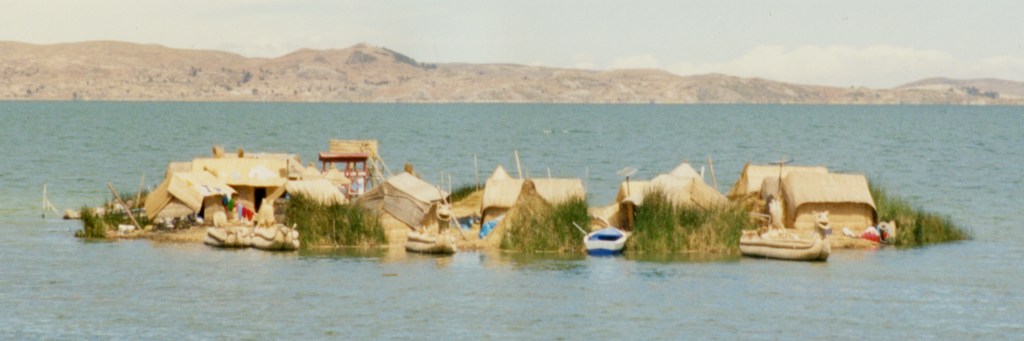
Originally they were conquered by the Incas, who expected tax money. In order not to pay, they ran away and built the floating islands.
There they were left alone. Unfortunately, being so isolated, there was a great deal of in-breeding over the centuries and the Uros were dying away. In the 1910s some Aymaras (another Indian tribe) found and mingled with the Uros. It was only then that the Uros learned that the Incas were gone. The last pure Uros died in 1959.
These amazing man-made islands are in shallow water and are made of mud and dry reeds. The reeds are replaced as the old reeds rot. It is spongy and feels funny to walk on.
We took a ride in a reed boat from one island to another island. There are 40 islands in all.

How do they live on these little floating islands? Mainly they live on fish. They have no drinking water except from Lake Titicaca, which has a bit of salt in it. I imagine that they will survive only as a tourist attraction now.
The Inca Trail and Machu Pichu
The Milford Track, introduced me to multi-day hiking. Now I was set to hike the Inca Trail. Only 3 out of the 8 of the group chose the Inca Trail option, which is not surprising since it is a very difficult hike and requires camping.
First some history: The trail was built by the Inca Indians about 700 years ago. We hiked 24 miles of the trail, which leads one to believe that it should be easier than the Milford Track’s 34 miles, but not so. The trail was mostly up and down with steep grades. For instance, on the “hard day” we climbed 4,400 feet. A good portion of the trail is paved with stones, but that does not make the walking easier, because some of the stones are very high: they range from 6 inches to 2 feet each. I climbed each tall step with difficulty (even though I had my hiking stick). It is incredible to think of the Incas bringing these huge stones to the middle of the trek to build the road. The purpose of this hike was not just to exhaust ourselves, but to see the fabulous Inca ruins on the way to Machu Pichu.
The hike started with a train ride out of Cusco to Kilometer 88, which is at 8,200 ft. Luckily, I had been at high altitude for awhile and was acclimated. A one -mile hike took us to our first camp site on the land of a hacienda called Quente. We slept in tents but had electricity and showers, so it wasn’t really camping.
This hike was very different from the Milford Trek. Where in the Milford Trek I had to carry all my gear but slept in beds and showered each day. Here I only had to carry a day pack for my water bottle and extra shirt. We had sherpers to carry our tents, food and water from camp to camp. The terrain was also very different from New Zealand. Instead of walking through pristine forests, we hiked through abandoned Inca towns and ruins as well as through rain forests and fields. In my opinion, the ruins along the way were more fascinating that those of Machu Pichu and not overrun by tourists.
Since it was the end of the season (November), there were only 3 of us hikers plus our guide, with 8 sherpers/cooks. (We were actually supposed to be 5 hikers, but the two others became sick a day before the trip).
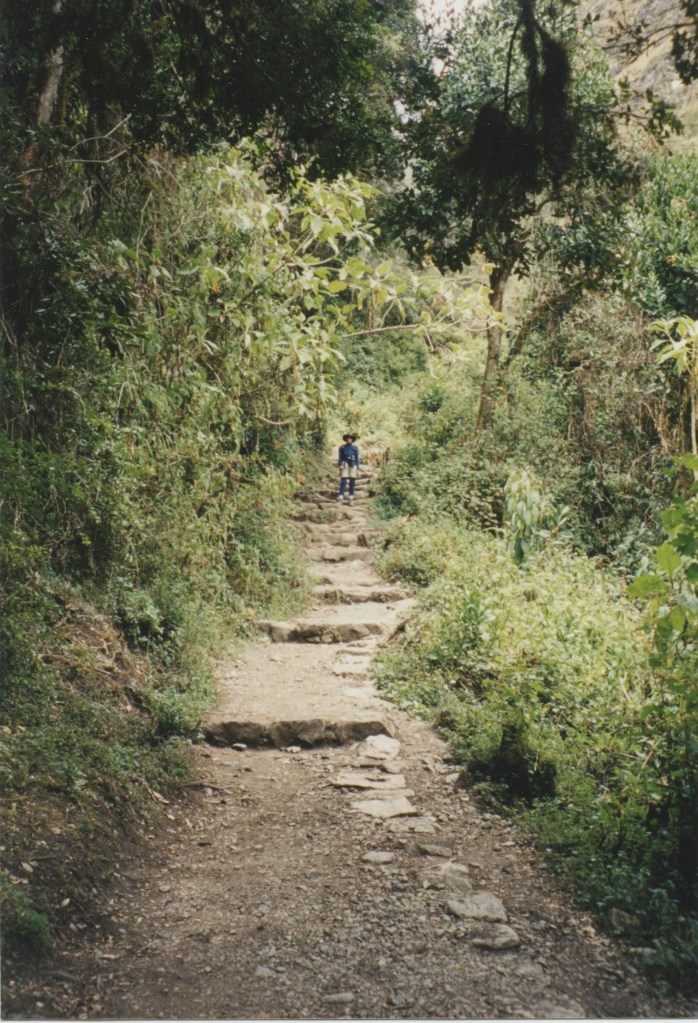
We started off “easy”, with a mild 400-foot climb to the first set of ruins; the interesting Llactapata Inca ruins at 8,622 ft. Then the fun began as we continued with a 20-degree grade climb to our morning break. The walking got tougher as we went up Inca steps up and up and up. By lunch time we had hiked up about 1,200 feet.
Lunch was wonderful. The porters had set up a table and chairs. We had pasta and hot apple juice. Then mosquitoes arrived, therefore instead of resting, we quickly continued hiking. We walked through a beautiful rain forest. It was hard going and at times I found myself thinking – “why am I doing this to myself”.
But the river we were following and the views were incredible. By 3 PM we arrived at camp Llullucha after climbing another 3,200 ft. In all we climbed 4,400 feet and walked 7.5 miles. The miles weren’t much but the climb was tough.
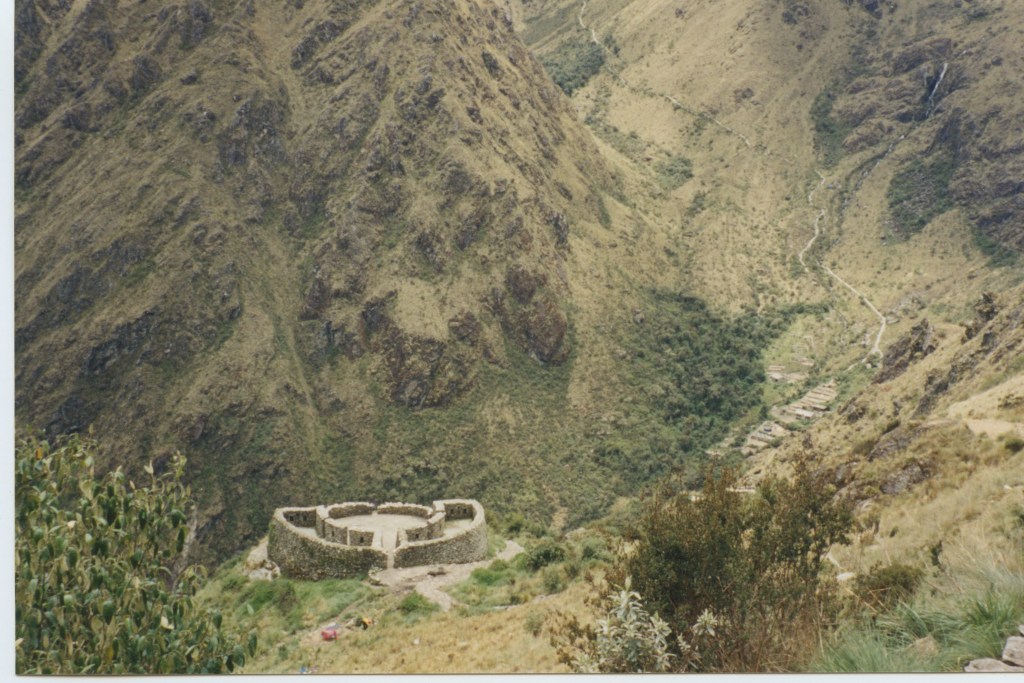
While we were resting after a delicious tea, a huge storm came up and blew our dinner tent away. The porters had to scramble to get it back up in the rain. However, by 6:30 the rain stopped and we had an excellent dinner by candlelight. The day’s hike and tiredness melted away. It felt worth while.
Unfortunately, the next day was even harder. We started at 6:40 AM and walked until 5 PM. The first hour and a half was at a 30-degree angle for about 1,500 feet to the first pass. The view from the top of the pass was magnificent from every angle. I won’t detail all the ups and downs and the ruins along the way, but I do want to mention the Sayacmarca ruins. We reached them almost at the end of the day and of course, the ruins were a bit off the road and up lots of steps. But they were so worth it! We saw a young couple who were doing the same hike, and they skipped these ruins because they were too tired.
The last hour was the toughest because we were walking along a cliff edge much of the time and we had to keep our concentration while exhausted.
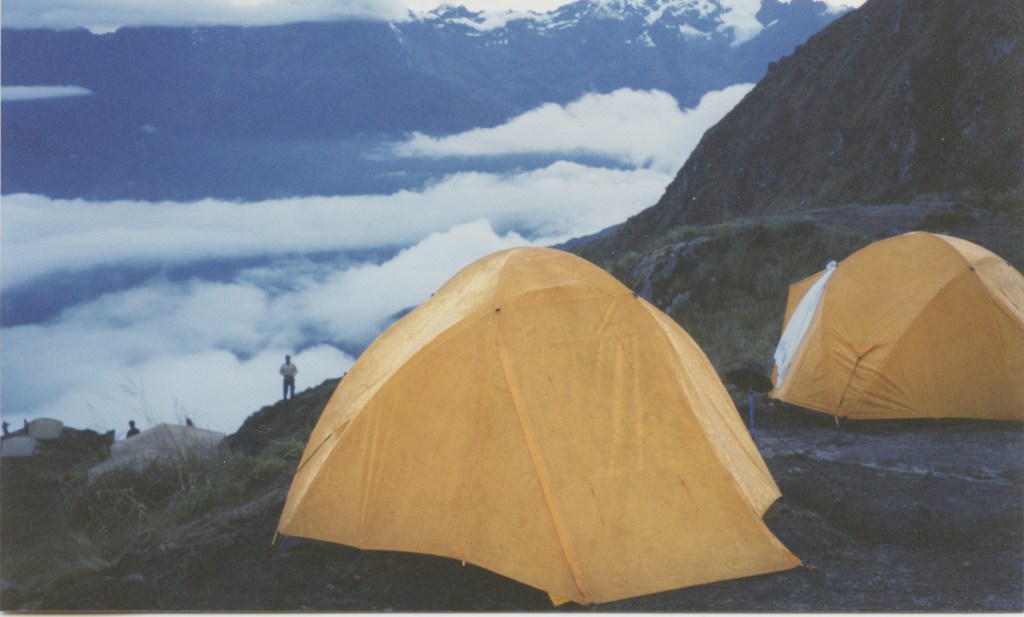
Finally, at 5 PM we reached camp, high on a pass, above the clouds with unbelievable views. Our tents were at the top of the hill above the cooking and dining tents -straight up. It was muddy so it was a challenge to get to the tent, especially after so many hours of walking.
After pre-dinner tea and popcorn, we decided to stay in the dining tent and chat and drink Piso Sours rather than go back up to the tents between tea and dinner. By the time dinner was over, it was dark and all we had were a couple of little of flash lights, insufficient to light our way up the hill. The porters came to our aid with flashlights.
On the last day we were up at 5 AM to watch the sunrise at the top of the world. Being above the clouds, with glacier mountains all around, made it magnificent. We had a wonderful breakfast of pancakes. Then the porters lined up for their pictures and tips as we said good bye to them. We hiked the rest of the way to Machu Pichu just with our guide.
On the way, we saw the Phuyupatamarca ruins, which were the most incredible yet, with fountains and wonderful constructions.
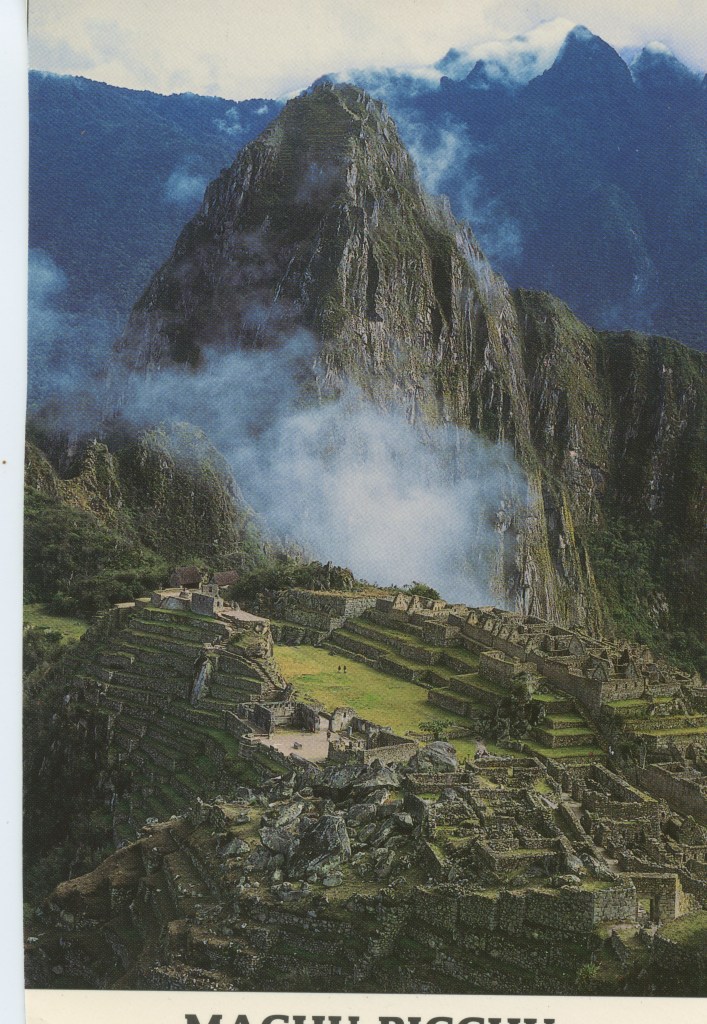
At about 12:30 we reached the Gate of the Sun and could see our destination: Machu Pichu (M-P). As we entered M-P, we ran into the rest of our group, the ones that had gone to the Amazon, a total coincidence. We toured the city with them for about 1.5 hours. M-P is incredible but is over run by tourists, which made us really appreciate having had the ruins along the hike to ourselves, to feel the ancient places. After the hike, M-P was a bit of a let down.
There were many more adventures in Peru, but I will only mention that we drove down the coast and saw the Nazca lines from a small plane. The carvings on the rocks were made some 2,000 years ago and they are amazing.
Final comments:
- Good hiking boots and sticks are a must for difficult hikes
- Small group travel is intimate. The plus: being able to always hear the guide. The negative: one annoying person is hard to avoid.
- Off season is great because the crowds are sparce. This was especially great at the sites on the Inca Trail.
- Camping is challenging but the rewards are great.
- Hiking lets you get away from the crowds.
The next post will pick up with the Thailand and Nepal trip in October 2001. I will skip over the Winter 2001 trips to Switzerland, Italy and France with my brother and his family. I will only note that being in Florence in February is great. We were the only tourists looking at The David sculpture in Florence. Also, June, 2001 we went on a Jane Austen pilgrimage to England. Being a specialized trip, we had access to private homes and special treatment.
 Nili's Adventure